How many equivalents of hydrogen gas (H2) are required to fully reduce 1-decyne (an alkyne) to decane (an alkane) via catalytic hydrogenation?
To fully reduce 1-decyne to decane, 2 equivalents of hydrogen gas (H2) are required. Each equivalent of H2 adds two hydrogens: the first equivalent reduces the triple bond to a double bond, and the second equivalent reduces the double bond to a single bond, resulting in a fully saturated alkane.
What is the product formed when cyclohexene is reacted with hydrogen gas (H2) in the presence of a platinum (Pt) catalyst?
When cyclohexene is reacted with hydrogen gas (H2) in the presence of a platinum (Pt) catalyst, the product is cyclohexane. The double bond in cyclohexene is fully saturated, converting it into the corresponding alkane while the ring structure remains intact.
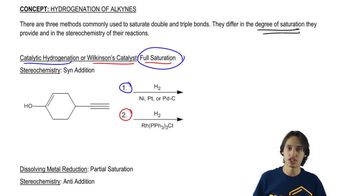
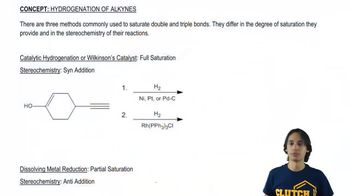
What is the main difference between full saturation and partial saturation in hydrogenation of alkynes?
Full saturation converts triple or double bonds completely to single bonds, while partial saturation stops at the double bond stage. Full saturation uses catalysts like Pt, Pd, or Wilkinson's, whereas partial saturation uses different reagents.
Which catalyst is used in full saturation hydrogenation that contains rhodium, triphenylphosphine, and chlorine?
Wilkinson's catalyst is used for full saturation and contains rhodium, triphenylphosphine, and chlorine. It fully saturates double and triple bonds to alkanes.
What is the stereochemical outcome of hydrogen addition in catalytic hydrogenation of alkynes?
Catalytic hydrogenation of alkynes results in syn addition, meaning both hydrogens add to the same side. This typically leads to cis products if a double bond is formed.
What is the effect of hydrogenation reactions on ring structures in hydrocarbons?
Hydrogenation reactions do not affect ring structures; rings remain intact. Only double and triple bonds are reduced during these reactions.
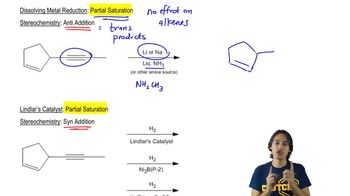
What type of addition and product stereochemistry does dissolving metal reduction produce when reducing alkynes?
Dissolving metal reduction produces anti addition, resulting in trans (E) double bonds. This method is unique for generating trans-alkenes from alkynes.
What are some alternative names or reagents for Lindlar's catalyst used in partial hydrogenation?
Lindlar's catalyst may also be referred to as the P-2 catalyst or as a combination of lead acetate and quinoline. All these are considered 'poisoned catalysts' that stop reduction at the alkene stage.
Why are Lindlar's and similar catalysts referred to as 'poisoned catalysts'?
They are called 'poisoned catalysts' because they are modified to prevent complete hydrogenation, stopping at the alkene stage. This allows selective partial reduction of alkynes to cis-alkenes.
How does the stereochemistry of the product differ between Lindlar's catalyst and dissolving metal reduction?
Lindlar's catalyst gives syn addition, resulting in cis-alkenes, while dissolving metal reduction gives anti addition, resulting in trans-alkenes. The choice of reagent determines the geometry of the resulting double bond.