Back

Hydrogenation quiz

Control buttons has been changed to "navigation" mode.
1/15
  • What is catalytic hydrogenation in organic chemistry?

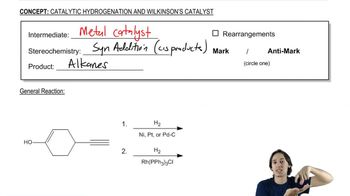
    Catalytic hydrogenation is the addition of hydrogen to double or triple bonds, converting them into alkanes using a metal catalyst.
  • Which metal catalysts are commonly used in catalytic hydrogenation?

    Nickel, platinum, and palladium are commonly used as metal catalysts in catalytic hydrogenation.
  • What type of addition (syn or anti) occurs during catalytic hydrogenation?

    Catalytic hydrogenation results in syn addition, where both hydrogens add to the same side of the double bond.
  • What is the typical product of catalytic hydrogenation of an alkene?

    The typical product is an alkane, as all double bonds are converted to single bonds by the addition of hydrogens.
  • Does catalytic hydrogenation involve carbocation intermediates or rearrangements?

    No, catalytic hydrogenation does not involve carbocation intermediates or rearrangements.
  • Does Markovnikov's rule apply to catalytic hydrogenation?

    No, Markovnikov's rule does not apply because only hydrogen atoms are added, not different groups.
  • What is Wilkinson's catalyst and what is its role in hydrogenation?

    Wilkinson's catalyst is a rhodium complex with triphenylphosphine and chlorine, and it promotes hydrogenation similarly to other metal catalysts.
  • How many hydrogens are added for each pi bond during catalytic hydrogenation?

    Two hydrogens are added for each pi bond present in the molecule.
  • What happens to the carbon backbone of a molecule during catalytic hydrogenation?

    The carbon backbone remains unchanged; only the double or triple bonds are converted to single bonds by adding hydrogens.
  • What is the stereochemical outcome of catalytic hydrogenation?

    The reaction produces cis (syn addition) products, with both hydrogens added to the same side of the former double bond.
  • Can deuterium (D2) be used instead of hydrogen (H2) in catalytic hydrogenation?

    Yes, D2 can be used, and the reaction mechanism remains the same, with deuterium atoms adding instead of hydrogen.
  • What is the general appearance of the product after catalytic hydrogenation?

    The product is fully saturated (an alkane), with all double or triple bonds replaced by single bonds and added hydrogens.
  • What is the role of the metal catalyst in catalytic hydrogenation?

    The metal catalyst coordinates the hydrogens to add from the same side of the double bond, ensuring syn addition.
  • If a molecule has two double bonds, how many hydrogens are added during complete catalytic hydrogenation?

    Four hydrogens are added, two for each double bond.
  • Does catalytic hydrogenation affect other functional groups like alcohols in the molecule?

    No, catalytic hydrogenation typically does not affect other functional groups such as alcohols; only the double or triple bonds are reduced.