What are the products formed when a lactone (a cyclic ester) undergoes acid-catalyzed hydrolysis?
Acid-catalyzed hydrolysis of a lactone produces a carboxylic acid with a terminal hydroxyl group, effectively opening the ring to yield a hydroxy acid.
What is the main difference between the products of acid-catalyzed and base-catalyzed hydrolysis of thioesters?
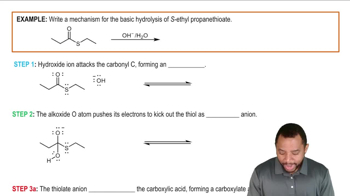
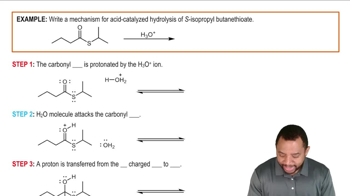
Acid-catalyzed hydrolysis yields a carboxylic acid and a thiol, while base-catalyzed hydrolysis (saponification) produces a carboxylate anion and a thiol. The carboxylic acid is deprotonated in basic conditions.
Which steps in the acid-catalyzed hydrolysis of thioesters involve proton movement?
Steps 1 (protonation), 3 (proton transfer), and 5 (deprotonation) all involve the movement of a proton. These steps are essential for the mechanism's progression.
What is the role of the nucleophile in the hydrolysis of thioesters?
The nucleophile attacks the carbonyl carbon of the thioester, initiating the substitution process. This step is crucial for both acid and base-catalyzed mechanisms.
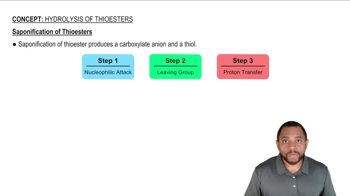
Why does saponification of thioesters result in a carboxylate anion instead of a carboxylic acid?
The basic environment deprotonates the carboxylic acid, forming a carboxylate anion. Carboxylic acids cannot remain protonated under strongly basic conditions.
What is the leaving group in the hydrolysis of thioesters?
The leaving group in thioester hydrolysis is the thiol. It departs during the nucleophilic acyl substitution mechanism.
How does the mechanism of base-catalyzed hydrolysis of thioesters differ from the acid-catalyzed version?
Base-catalyzed hydrolysis involves nucleophilic attack, leaving group loss, and proton transfer, while acid-catalyzed hydrolysis includes additional protonation and deprotonation steps. The base mechanism is generally shorter and does not require initial protonation.
What term is used to describe the base-catalyzed hydrolysis of thioesters?
The base-catalyzed hydrolysis of thioesters is called saponification. This process produces a carboxylate anion and a thiol.
Why are thioesters considered sulfur analogs of esters?
Thioesters have a sulfur atom replacing the oxygen atom found in regular esters. This substitution gives thioesters distinct chemical properties.
What is the general outcome of hydrolyzing a thioester under either acidic or basic conditions?
Hydrolysis of a thioester always produces a thiol and a carboxylic acid or its anion. The specific form of the acid depends on the reaction conditions.