What intermolecular force is primarily responsible for the high boiling points and water solubility of smaller amides?
Hydrogen bonding is the primary intermolecular force responsible for the high boiling points and water solubility of smaller amides, as it is the strongest type of intermolecular force and occurs when hydrogen is bonded to highly electronegative atoms such as nitrogen or oxygen.
How can you determine which compound in a mixture is the least polar using thin-layer chromatography (TLC)?
In thin-layer chromatography (TLC), the least polar compound in a mixture will travel the farthest up the plate because it interacts less with the polar stationary phase and more with the nonpolar mobile phase.
What types of intermolecular forces are present between two molecules of CH3OCH2CH3 (ethyl methyl ether)?
Between two molecules of CH3OCH2CH3 (ethyl methyl ether), the intermolecular forces present are dipole-dipole interactions (due to the polar C–O bond) and Van der Waals (London dispersion) forces. Ethyl methyl ether does not exhibit hydrogen bonding because it lacks a hydrogen atom directly bonded to oxygen.
What is the key difference between intermolecular forces and chemical bonds?
Intermolecular forces exist between molecules and do not change the chemical composition, while chemical bonds are within molecules and determine the compound's structure. IMFs influence physical properties like boiling and melting points.
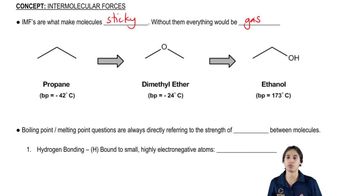
Why would all substances be gases in the absence of intermolecular forces?
Without intermolecular forces, molecules would not stick together and would disperse completely, resulting in only the gas phase. IMFs are necessary for the formation of liquids and solids.
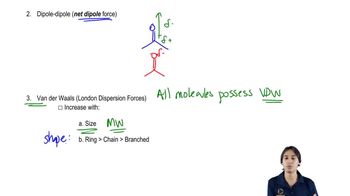
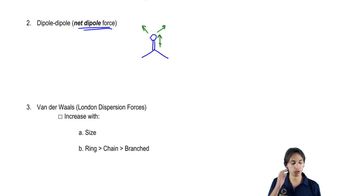
How does the presence of a net dipole in a molecule enable dipole-dipole interactions?
A net dipole creates regions of partial positive and negative charge, allowing molecules to align so that oppositely charged regions attract. This alignment leads to dipole-dipole interactions between molecules.
What two molecular features increase the strength of Van der Waals forces?
The strength of Van der Waals forces increases with higher molecular weight and more symmetrical molecular shapes. These features allow molecules to stack more efficiently and interact more strongly.
Why does ethanol have a much higher boiling point than propane or dimethyl ether despite similar molecular weights?
Ethanol can form hydrogen bonds, which are much stronger than the IMFs present in propane or dimethyl ether. This strong interaction requires more energy to break, resulting in a higher boiling point.
How does molecular shape affect the ability of molecules to stack and thus their Van der Waals forces?
Molecules with symmetrical shapes, like rings, can stack more neatly and closely, increasing Van der Waals forces. Branched or irregular shapes stack poorly, resulting in weaker Van der Waals interactions.
What is the order of strength for the three main types of intermolecular forces discussed?
The order from strongest to weakest is hydrogen bonding, dipole-dipole interactions, and Van der Waals forces. This order determines the relative boiling and melting points of substances.
 Back
Back

 01:46
01:46