Back

Leaving Group Conversions Summary definitions

Control buttons has been changed to "navigation" mode.
1/15
  • Alcohol

    A compound with a hydroxyl group attached to a saturated carbon, often converted to better leaving groups in substitution reactions.
  • Leaving Group

    An atom or group that departs with a pair of electrons during a substitution or elimination reaction, influencing reaction pathways.
  • Stereochemistry

    The study of spatial arrangement of atoms in molecules and its effect on chemical reactions, crucial in substitution mechanisms.
  • SN1 Reaction

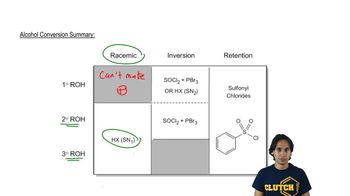
    A two-step substitution mechanism involving carbocation formation, leading to racemic mixtures due to planar intermediates.
  • SN2 Reaction

    A one-step substitution mechanism with backside attack, resulting in inversion of configuration at the reactive center.
  • Carbocation

    A positively charged carbon intermediate formed during SN1 reactions, essential for racemization in alcohol conversions.
  • Racemic Mixture

    A 1:1 blend of two enantiomers, typically produced when a planar intermediate allows attack from either side.
  • Inversion of Configuration

    A stereochemical outcome where the spatial arrangement at a chiral center is flipped, characteristic of SN2 reactions.
  • Retention of Configuration

    A stereochemical result where the spatial arrangement at a chiral center remains unchanged after reaction.
  • Sulfonyl Chloride

    A reagent used to convert alcohols into sulfonate esters, enabling retention of configuration regardless of alcohol type.
  • Sulfonate Ester

    A product formed from alcohols and sulfonyl chlorides, serving as an excellent leaving group in further reactions.
  • SOCl2

    A reagent that transforms alcohols into alkyl chlorides with inversion of configuration via an SN2 pathway.
  • PBr3

    A reagent that converts alcohols to alkyl bromides with inversion of configuration, favoring SN2 mechanisms.
  • Lucas Reagent

    A mixture of HCl and ZnCl2, used to convert alcohols to alkyl chlorides, especially effective for secondary and tertiary alcohols.
  • Backside Attack

    A nucleophilic approach opposite the leaving group, required for inversion of configuration in SN2 reactions.