Back

Leaving Group Conversions Summary quiz

Control buttons has been changed to "navigation" mode.
1/15
  • What type of alcohols can react with HX in an SN1 reaction to give a racemic mixture?

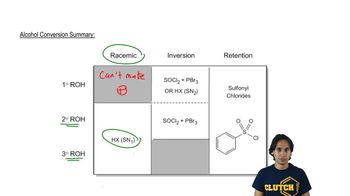
    Secondary and tertiary alcohols can react with HX in an SN1 reaction to give a racemic mixture due to carbocation formation.
  • Why can't primary alcohols undergo SN1 reactions with HX to give racemic mixtures?

    Primary alcohols cannot form stable carbocations, so they do not undergo SN1 reactions and cannot give racemic mixtures.
  • What mechanism do primary alcohols follow when reacting with HX?

    Primary alcohols react with HX via an SN2 mechanism, leading to inversion of configuration.
  • Which reagents can be used to achieve inversion of configuration with primary alcohols?

    HX, SOCl2, and PBr3 can be used with primary alcohols to achieve inversion of configuration.
  • Why can't SOCl2 or PBr3 be used for inversion with tertiary alcohols?

    Tertiary alcohols are too sterically hindered for backside attack, so inversion with SOCl2 or PBr3 is not possible.
  • What is the stereochemical outcome when secondary alcohols react with HX?

    Secondary alcohols reacting with HX typically give a racemic mixture due to SN1 mechanism and carbocation formation.
  • How can retention of configuration be achieved when converting alcohols to leaving groups?

    Retention of configuration is achieved by converting alcohols to sulfonate esters using sulfonyl chlorides.
  • Does the use of sulfonyl chlorides for retention of configuration depend on the degree of alcohol?

    No, sulfonyl chlorides can be used for primary, secondary, or tertiary alcohols to achieve retention of configuration.
  • What is the role of the Lucas reagent in alcohol conversion reactions?

    The Lucas reagent (HCl with ZnCl2) is used to convert alcohols to alkyl chlorides, especially for secondary and tertiary alcohols.
  • Why is inversion of configuration not possible with tertiary alcohols?

    Inversion is not possible with tertiary alcohols because steric hindrance prevents backside attack.
  • What is the stereochemical result of converting a secondary alcohol with SOCl2 or PBr3?

    Converting a secondary alcohol with SOCl2 or PBr3 typically leads to inversion of configuration.
  • What is the main difference in stereochemical outcome between SN1 and SN2 mechanisms?

    SN1 mechanisms produce racemic mixtures due to planar carbocation intermediates, while SN2 mechanisms result in inversion of configuration.
  • What type of product is formed when a tertiary alcohol is converted to a leaving group using HX?

    A racemic mixture is formed due to the SN1 mechanism and carbocation intermediate.
  • Can sulfonate esters be formed from all types of alcohols?

    Yes, sulfonate esters can be formed from primary, secondary, and tertiary alcohols.
  • Why is it important to know the stereochemical outcome of alcohol leaving group conversions?

    Professors often test on stereochemistry, and different reagents and mechanisms lead to different stereochemical outcomes.