Back

Lewis Structure definitions

Control buttons has been changed to "navigation" mode.
1/13
  • Lewis Structure

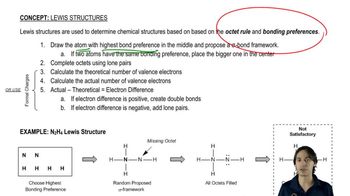
    A diagram showing all atoms, bonds, and lone pairs in a molecule, making electron arrangement explicit.
  • Octet Rule

    A guideline stating atoms tend to surround themselves with eight electrons to achieve stability.
  • Bonding Preference

    A tendency of an atom to form a specific number of bonds based on its group and electron configuration.
  • Sigma Bond Framework

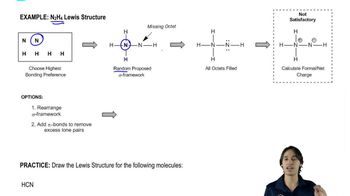
    An initial arrangement of single bonds connecting atoms, serving as the backbone for a molecule's structure.
  • Electropositive Atom

    An element positioned farthest from fluorine in the periodic table, often placed at the center of a structure.
  • Lone Pair

    A pair of valence electrons not involved in bonding, often used to complete octets in structures.
  • Valence Electrons

    The outermost electrons of an atom, crucial for determining bonding and structure in molecules.
  • Electron Difference

    The result of subtracting actual electrons in a structure from the theoretical count, guiding bond adjustments.
  • Double Bond

    A connection between two atoms involving two shared pairs of electrons, often formed to reduce excess electrons.
  • Formal Charge

    A calculated value indicating the charge distribution on an atom within a molecule, aiding in structure validation.
  • Molecular Formula

    A notation indicating the types and numbers of atoms present in a molecule, serving as a starting point for structures.
  • Trial and Error

    An iterative process of adjusting bond arrangements to achieve a valid and stable electron configuration.
  • Central Atom

    The atom placed at the center of a Lewis structure, typically the most electropositive or with highest bonding preference.