Organic Chemistry
My Course
Learn
Exam Prep
AI Tutor
Study Guides
Textbook Solutions
Flashcards
Explore
My Course
Learn
Exam Prep
AI Tutor
Study Guides
Textbook Solutions
Flashcards
Explore
Back
Ligands definitions
You can tap to flip the card.
Define:
Ligand
You can tap to flip the card.
👆
Ligand
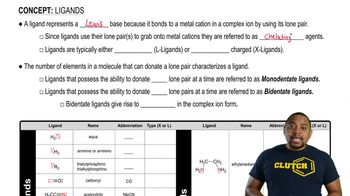
Lewis base donating lone pairs to a metal cation, forming a coordinate bond in a complex ion.
Track progress
Control buttons has been changed to "navigation" mode.
1/15
Related flashcards
Related practice
Recommended videos
Ligands quiz
Ligands
10 Terms
27. Transition Metals
6 topics
14 problems
Chapter
Johnny
Guided course
02:01
Ligands
Johnny Betancourt
587
views
1
rank
Guided course
08:24
Ligands
Johnny Betancourt
717
views
Guided course
01:46
Ligands Example 1
Johnny Betancourt
584
views
Terms in this set (15)
Hide definitions
Ligand
Lewis base donating lone pairs to a metal cation, forming a coordinate bond in a complex ion.
Lewis Base
Species with a lone pair available for donation to a Lewis acid, enabling complex ion formation.
Lewis Acid
Species, often a metal cation, accepting electron pairs from ligands to form coordinate bonds.
Monodentate Ligand
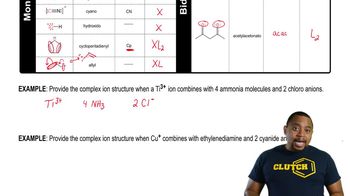
Molecule or ion donating a single lone pair from one atom to a metal center in a complex.
Bidentate Ligand
Molecule or ion donating two lone pairs from different atoms, often forming a ring with the metal.
Chelating Agent
Ligand capable of forming multiple bonds to a single metal ion, increasing complex stability.
L Ligand
Neutral molecule acting as a ligand, donating lone pairs without carrying a charge.
X Ligand
Negatively charged ligand donating lone pairs, contributing to the overall charge of the complex.
Complex Ion
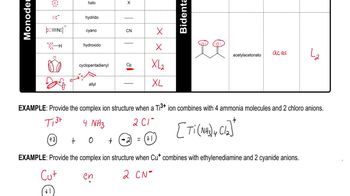
Structure formed when ligands coordinate to a central metal cation via lone pair donation.
Donor Atom
Specific atom within a ligand responsible for providing a lone pair to the metal center.
Pi Bond
Bond formed by sideways overlap of p orbitals, sometimes serving as a source of electron donation in ligands.
Abbreviation
Shortened notation for ligands, such as CO for carbon monoxide or EN for ethylenediamine.
Resonance
Delocalization of electrons within a ligand, allowing multiple atoms or bonds to serve as electron donors.
Transition Metal
Central metal ion in a complex, typically accepting electron pairs from surrounding ligands.
Cyclic Complex
Ring structure formed when a bidentate ligand coordinates to a metal at two sites simultaneously.