Organic Chemistry
My Course
Learn
Exam Prep
AI Tutor
Study Guides
Textbook Solutions
Flashcards
Explore
Try the app
My Course
Learn
Exam Prep
AI Tutor
Study Guides
Textbook Solutions
Flashcards
Explore
Try the app
Back
Merrifield Solid-Phase Peptide Synthesis definitions
You can tap to flip the card.
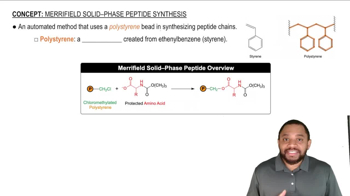
Polystyrene
You can tap to flip the card.
👆
Polystyrene
A polymer support used as a solid bead, enabling peptide chain assembly through covalent attachment of amino acids.
Track progress
Control buttons has been changed to "navigation" mode.
1/15
Related flashcards
Recommended videos
Merrifield Solid-Phase Peptide Synthesis quiz
Merrifield Solid-Phase Peptide Synthesis
15 Terms
1:53
Merrifield Solid-Phase Peptide Synthesis Concept 1
604
views
4:51
Merrifield Solid-Phase Peptide Synthesis Example 1
640
views
4:43
Merrifield Solid-Phase Peptide Synthesis Concept 2
680
views
Terms in this set (15)
Hide definitions
Polystyrene
A polymer support used as a solid bead, enabling peptide chain assembly through covalent attachment of amino acids.
Chloromethylated Polystyrene
A functionalized bead with chloromethyl groups, serving as the initial anchor for amino acid attachment in synthesis.
Protected Amino Acid
An amino acid modified with a blocking group to prevent unwanted reactions during peptide chain assembly.
Acyl Group
A chemical group used to temporarily block the amino end of an amino acid, ensuring selective peptide bond formation.
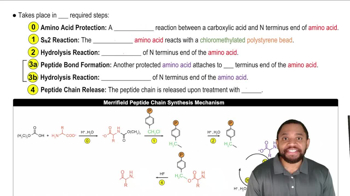
SN2 Reaction
A nucleophilic substitution mechanism enabling the covalent linkage of a protected amino acid to the bead.
Hydrolysis
A reaction used to remove protecting groups, exposing reactive sites for further peptide chain elongation.
Peptide Bond
A covalent linkage formed between the carboxyl group of one amino acid and the amino group of another.
DCC
A coupling agent that facilitates peptide bond formation by absorbing water produced during condensation.
Condensation Reaction
A process where two molecules join, releasing water, crucial for forming peptide bonds during synthesis.
Hydrofluoric Acid
A reagent used to cleave the completed peptide chain from the solid support at the end of synthesis.
Deprotection
The removal of a blocking group from an amino acid, restoring its reactivity for further chain extension.
Peptide Chain
A sequence of amino acids covalently linked, synthesized stepwise on a solid support in this method.
N Terminus
The free amino end of a peptide or amino acid, often protected and deprotected during synthesis cycles.
Polymerization
The process of chemically linking monomers, such as styrene, to form the polystyrene support.
Waste
Byproducts generated during synthesis, including spent protecting groups and fragments from bead cleavage.