Organic Chemistry
My Course
Learn
Exam Prep
AI Tutor
Study Guides
Textbook Solutions
Flashcards
Explore
My Course
Learn
Exam Prep
AI Tutor
Study Guides
Textbook Solutions
Flashcards
Explore
Back
Merrifield Solid-Phase Peptide Synthesis quiz
You can tap to flip the card.
Define:
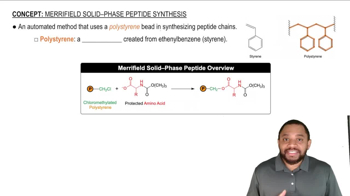
What type of bead is used as the solid support in Merrifield solid-phase peptide synthesis?
You can tap to flip the card.
👆
What type of bead is used as the solid support in Merrifield solid-phase peptide synthesis?
Chloromethylated polystyrene beads are used as the solid support.
Track progress
Control buttons has been changed to "navigation" mode.
1/15
Related flashcards
Recommended videos
Merrifield Solid-Phase Peptide Synthesis definitions
Merrifield Solid-Phase Peptide Synthesis
15 Terms
Guided course
1:53
Merrifield Solid-Phase Peptide Synthesis Concept 1
Johnny Betancourt
548
views
Guided course
4:43
Merrifield Solid-Phase Peptide Synthesis Concept 2
Johnny Betancourt
638
views
Guided course
4:51
Merrifield Solid-Phase Peptide Synthesis Example 1
Johnny Betancourt
578
views
Terms in this set (15)
Hide definitions
What type of bead is used as the solid support in Merrifield solid-phase peptide synthesis?
Chloromethylated polystyrene beads are used as the solid support.
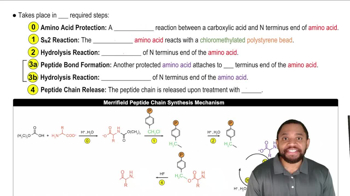
What is the purpose of protecting the amino group of an amino acid in this synthesis?
The amino group is protected to prevent unwanted reactions during peptide chain assembly.
Which reaction mechanism is used to attach the first protected amino acid to the polystyrene bead?
An SN2 nucleophilic substitution mechanism is used for attachment.
What is the role of DCC in the Merrifield peptide synthesis?
DCC facilitates peptide bond formation by absorbing the water produced during the condensation reaction.
How is the protecting group removed from the amino acid during the synthesis cycle?
The protecting group is removed by hydrolysis, exposing the free amino group.
What chemical is used to cleave the completed peptide chain from the polystyrene bead?
Hydrofluoric acid (HF) is used to release the peptide chain from the bead.
What type of reaction forms the peptide bond between amino acids in this method?
A condensation reaction forms the peptide bond, with the loss of water.
Why is the process called 'solid-phase' peptide synthesis?
Because the peptide chain is assembled on a solid polystyrene bead, not in solution.
What is the function of the chloromethyl group on the polystyrene bead?
It acts as a reactive site for the SN2 attachment of the first protected amino acid.
What happens to the polystyrene bead after the peptide chain is cleaved?
The bead remains as waste, while the peptide is isolated.
What is the repeating cycle in Merrifield synthesis for elongating the peptide chain?
The cycle involves deprotection, coupling with a protected amino acid, and repetition as needed.
What is the initial preparation step (step 0) before the main synthesis steps?
Amino acid protection, where the amino group is protected by an acyl group.
What is the main advantage of using the Merrifield solid-phase method?
It allows efficient and automated synthesis of peptides by iterative cycles on a solid support.
What is lost during the peptide bond formation step?
A molecule of water is lost during the condensation reaction.
How can the length of the peptide chain be controlled in this synthesis?
By repeating the cycles of deprotection and coupling with additional protected amino acids.