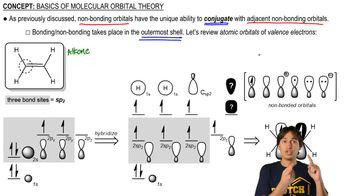
A framework explaining how atomic orbitals combine to form new orbitals that extend over an entire molecule, crucial for understanding bonding in organic compounds.
Conjugation
A phenomenon where electrons are delocalized across adjacent nonbonding orbitals, enhancing stability and enabling resonance in molecules.
Resonance
A situation where electrons are shared between multiple atoms, allowing for electron delocalization without moving atomic nuclei.
Hybridization
A process where atomic s and p orbitals blend to create new, equivalent orbitals, optimizing electron distribution for bonding.
sp2 Hybridization
A state where one s and two p orbitals mix, forming three planar orbitals ideal for creating double bonds in alkenes.
Atomic Orbital
A region around an atom where electrons are likely to be found, serving as the basis for forming molecular orbitals.
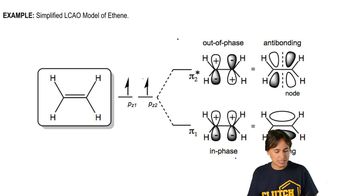
Molecular Orbital
A region in a molecule where electrons are likely to be found, resulting from the overlap of atomic orbitals from different atoms.
Bonding Orbital
A molecular orbital formed by constructive interference, increasing electron density between nuclei and stabilizing the molecule.
Antibonding Orbital
A molecular orbital formed by destructive interference, creating a node and reducing electron density between nuclei, leading to instability.
Node
A region in a molecular orbital where the probability of finding an electron is zero due to destructive interference.
Linear Combination of Atomic Orbitals
A method for predicting molecular orbital shapes by mathematically combining atomic orbitals, abbreviated as LCAO.
Constructive Interference
A wave interaction where orbital phases align, amplifying electron density and favoring bond formation.
Destructive Interference
A wave interaction where orbital phases oppose, canceling electron density and creating nodes.
Sigma Bond
A bond formed by head-on overlap of orbitals, concentrating electron density directly between two nuclei.
Pi Bond
A bond formed by side-to-side overlap of p orbitals, with electron density above and below the bonding axis.