Back

Monosaccharides - Acylation definitions

Control buttons has been changed to "navigation" mode.
1/15
  • Monosaccharide

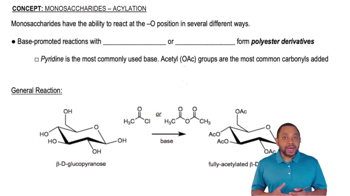
    A simple sugar molecule containing multiple hydroxyl groups, serving as a building block for carbohydrates.
  • Acylation

    A chemical process where acyl groups are introduced to a molecule, often enhancing its reactivity or stability.
  • Acid Chloride

    A reactive compound featuring a carbonyl bonded to a chlorine atom, commonly used to introduce acyl groups.
  • Anhydride

    A compound derived from two acids by removal of water, often used as an acylating agent in organic synthesis.
  • Pyridine

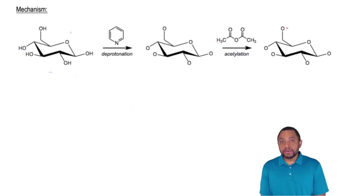
    A nitrogen-containing aromatic base, valued for its ability to deprotonate without interfering with acylating agents.
  • Acetyl Group

    A functional group with the structure CH3CO–, frequently added to molecules to form esters or amides.
  • OAC

    A shorthand notation for an oxygen atom bonded to an acetyl group, commonly seen in acetylated sugars.
  • Polyester Derivative

    A molecule formed when multiple ester linkages are introduced, often by acylating all hydroxyl groups of a sugar.
  • Nucleophilic Acyl Substitution

    A reaction mechanism where a nucleophile replaces a leaving group on a carbonyl carbon, forming a new bond.
  • Tetrahedral Intermediate

    A transient structure formed when a nucleophile attacks a carbonyl carbon, resulting in four substituents around the carbon.
  • Ester Linkage

    A bond formed between a carbonyl carbon and an oxygen atom, typically resulting from acylation of alcohols.
  • Leaving Group

    An atom or group that departs with a pair of electrons during a substitution or elimination reaction.
  • Glucopyranose

    A six-membered ring form of glucose, commonly used as a substrate in acylation reactions.
  • Base

    A substance capable of accepting protons or deprotonating other molecules, often facilitating nucleophilic reactions.
  • Hydroxyl Group

    A functional group consisting of an oxygen and hydrogen atom, making sugars reactive toward acylation.