Back

Monosaccharides - Acylation quiz

Control buttons has been changed to "navigation" mode.
1/15
  • What is the main purpose of monosaccharide acylation?

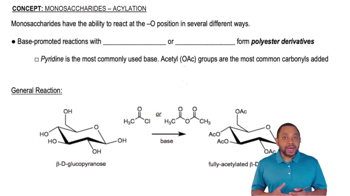
    The main purpose is to react monosaccharides with acid chlorides or anhydrides in the presence of a base to form polyester derivatives.
  • Which base is most commonly used in monosaccharide acylation and why?

    Pyridine is most commonly used because it can deprotonate the oxygen atoms without reacting with the acylating agents.
  • What is the condensed structure of an acetyl group as used in this reaction?

    The condensed structure is OAC, which represents an oxygen attached to a carbonyl and a methyl group.
  • What type of mechanism does monosaccharide acylation follow?

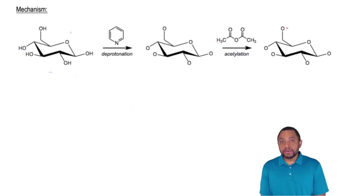
    It follows a nucleophilic acyl substitution (NAS) mechanism.
  • What is the role of pyridine in the acylation reaction?

    Pyridine acts as a base to deprotonate the hydroxyl groups, making them better nucleophiles.
  • Why is pyridine preferred over hydroxide as a base in this reaction?

    Pyridine is preferred because hydroxide could react with the acylating agent and hydrolyze it, while pyridine does not.
  • What is the typical product when beta D-glucopyranose undergoes full acylation?

    The typical product is a fully acetylated glucopyranose, where each oxygen atom is linked to an acetyl group.
  • What is the function of the negative charges generated on the oxygen atoms during the reaction?

    The negative charges make the oxygen atoms strong nucleophiles that can attack the acyl group.
  • What intermediate is formed during the nucleophilic acyl substitution mechanism?

    A tetrahedral intermediate is formed when the deprotonated oxygen attacks the acyl group.
  • What happens to the tetrahedral intermediate in the mechanism?

    The intermediate collapses, expelling a leaving group and forming the ester linkage.
  • Why is the product called a polyester derivative?

    It's called a polyester derivative because multiple ester linkages are formed between the monosaccharide and acetyl groups.
  • What would happen if a strong nucleophilic base like hydroxide was used instead of pyridine?

    Hydroxide could react with the acylating agent, leading to hydrolysis and formation of a carboxylate instead of the desired ester.
  • How many times does pyridine deprotonate the hydroxyl groups in glucopyranose during acylation?

    Pyridine deprotonates each hydroxyl group, typically five times for glucopyranose.
  • What is the significance of the OAC group in the final product?

    The OAC group represents the acetyl group attached to each oxygen, forming the ester linkage in the product.
  • Is the fully acetylated product called a pyranocyte? Why or why not?

    No, it's not called a pyranocyte because it contains additional oxygens, not just an R group at that position.