Monosaccharides - Forming Cyclic Hemiacetals quiz Flashcards

Monosaccharides - Forming Cyclic Hemiacetals quiz
Control buttons has been changed to "navigation" mode.
1/10
  • How many carbon dioxide molecules must be added to ribulose bisphosphate (RuBP) to make a single molecule of glucose?
    Six carbon dioxide molecules must be added to RuBP to make one molecule of glucose.
  • Which object converts sunlight into sugars?
    Chloroplasts in plant cells convert sunlight into sugars through photosynthesis.
  • A monosaccharide is formed from a polysaccharide in what kind of reaction?
    A monosaccharide is formed from a polysaccharide through a hydrolysis reaction.
  • What type of bonds are the bonds between simple sugar molecules in a carbohydrate?
    The bonds between simple sugar molecules in a carbohydrate are glycosidic bonds.
  • Which type of molecule is released when monosaccharides link together?
    Water molecules are released when monosaccharides link together in a dehydration synthesis reaction.
  • Monosaccharides may link together to form polysaccharides by forming which type of bond?
    Monosaccharides link together to form polysaccharides by forming glycosidic bonds.
  • Where does chemical digestion of table sugar (sucrose) begin?
    Chemical digestion of table sugar (sucrose) begins in the mouth with the enzyme salivary amylase.
  • What is the process called when monosaccharides form cyclic hemiacetals?
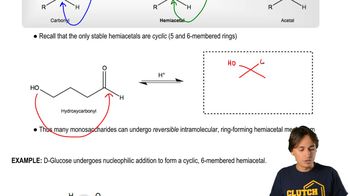
    The process is called cyclization, where an alcohol group within the same molecule attacks the carbonyl carbon.
  • What is the stability difference between hemiacetals and cyclic hemiacetals?
    Hemiacetals are generally unstable, but cyclic hemiacetals are stable due to the formation of a ring structure.
  • What is the role of the penultimate oxygen in the cyclization of D-glucose?
    The penultimate oxygen attacks the carbonyl group to form a stable six-membered cyclic hemiacetal.