Skip to main content
Organic Chemistry
My Course
Learn
Exam Prep
AI Tutor
Study Guides
Textbook Solutions
Flashcards
Explore
Try the app
My Course
Learn
Exam Prep
AI Tutor
Study Guides
Textbook Solutions
Flashcards
Explore
Try the app
Back
Moving Functionality definitions
You can tap to flip the card.
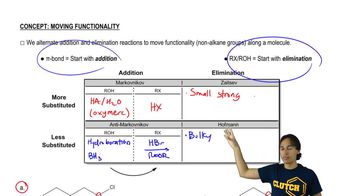
Zaitsev Elimination
You can tap to flip the card.
👆
Zaitsev Elimination
Formation of the more substituted alkene using a small, strong base, favoring the most stable double bond.
Track progress
Control buttons has been changed to "navigation" mode.
1/15
Related flashcards
Related practice
Recommended videos
Moving Functionality quiz
Moving Functionality
15 Terms
Moving Functionality
14. Synthetic Techniques
1 problem
Topic
Johnny
Alkynide Alkylation
14. Synthetic Techniques
8 problems
Topic
Laura
14. Synthetic Techniques
5 topics
13 problems
Chapter
Johnny
06:12
Propose a Synthesis
979
views
7
rank
9
comments
10:35
Moving Functionality in Synthesis
1138
views
11
rank
17
comments
03:48
Propose a Synthesis
1005
views
9
rank
7
comments
Terms in this set (15)
Hide definitions
Zaitsev Elimination
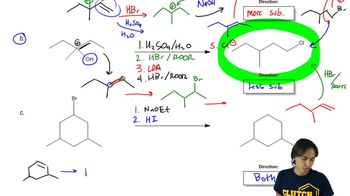
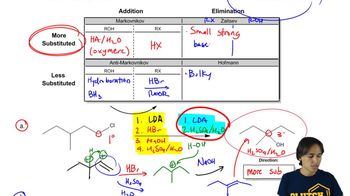
Formation of the more substituted alkene using a small, strong base, favoring the most stable double bond.
Hofmann Elimination
Formation of the less substituted alkene using a bulky base, favoring the least hindered double bond.
Markovnikov Addition
Addition of HX or oxymercuration to a double bond, placing the new group on the more substituted carbon.
Anti-Markovnikov Addition
Addition of HBr with peroxides or hydroboration, placing the new group on the less substituted carbon.
Carbocation Shift
Migration of a hydride or alkyl group to stabilize a carbocation, often leading to more substituted products.
Bulky Base
Large base, such as LDA, that favors elimination at less substituted positions by steric hindrance.
Small Strong Base
Compact, highly reactive base, like NaOEt, that promotes elimination at more substituted positions.
Oxymercuration
Addition method that avoids carbocation rearrangement, ensuring Markovnikov orientation without shifts.
Hydroboration
Addition of BH3 to alkenes, followed by oxidation, yielding anti-Markovnikov alcohols.
Acid-Catalyzed Dehydration
Conversion of alcohols to alkenes using acid, creating a good leaving group for elimination.
Synthetic Route
Sequence of reactions chosen to efficiently transform starting materials into desired products.
Leaving Group
Atom or group that departs with a pair of electrons during substitution or elimination reactions.
Retrosynthesis
Strategy of planning a synthesis by working backward from the target molecule to simpler precursors.
Radical Hydrohalogenation
Addition of HBr in the presence of peroxides, leading to anti-Markovnikov product formation.
Substitution Direction
Choice between targeting more or less substituted positions, guiding reagent selection and reaction outcome.
 BackBack

 06:12
06:12