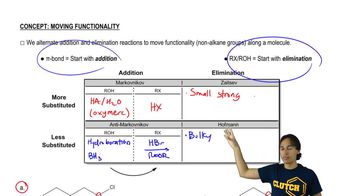
What type of base is favored for Zaitsev elimination?
A small, strong base is favored for Zaitsev elimination, which leads to the more substituted alkene.
Which type of base is used for Hofmann elimination?
A bulky base is used for Hofmann elimination, which favors the less substituted alkene.
What reagent is commonly used for Markovnikov addition to an alkene?
HX (such as HBr or HCl) is commonly used for Markovnikov addition, adding the halide to the more substituted carbon.
Which reagents are used for anti-Markovnikov addition of a halide to an alkene?
HBr with peroxides is used for anti-Markovnikov addition, placing the bromine on the less substituted carbon.
What is the preferred reagent for anti-Markovnikov addition of an alcohol to an alkene?
Hydroboration (using BH3) is preferred for anti-Markovnikov addition of an alcohol.
If you start with an alcohol, which reaction type should you perform first: addition or elimination?
You should perform an elimination reaction first when starting with an alcohol.
If you start with a double bond, which reaction type should you perform first: addition or elimination?
You should perform an addition reaction first when starting with a double bond.
How do you determine whether to use more substituted or less substituted reagents in a synthesis?
Identify the direction of substitution (more or less substituted) needed to reach your target and choose reagents accordingly.
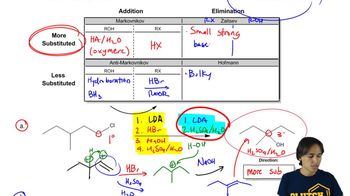
What is a good method to create a good leaving group from an alcohol for elimination?
Use acid-catalyzed dehydration, such as H2SO4 over H2O, to convert the alcohol into a good leaving group.
Why might you choose oxymercuration over HX for Markovnikov addition?
Oxymercuration is chosen when carbocation shifts are not possible or desired, as it avoids rearrangements.
Why can't SN2 reactions be used to substitute a halide on a tertiary carbon?
SN2 reactions cannot occur on tertiary carbons due to steric hindrance.
What is the advantage of choosing a synthetic route with fewer steps?
A route with fewer steps is generally more efficient and preferred in synthesis.
What is the role of carbocation shifts in these synthetic strategies?
Carbocation shifts can facilitate the formation of more substituted products by allowing rearrangement to a more stable carbocation.
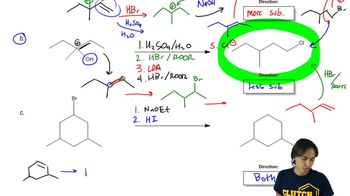
What is the typical sequence of reactions when moving functionality from a primary to a tertiary carbon?
First, perform elimination to form a double bond, then use Markovnikov addition to move the group to the more substituted (tertiary) carbon.
What is the main principle behind using addition and elimination reactions in organic synthesis?
Addition and elimination reactions are used to strategically move functional groups between atoms, often alternating between the two to achieve the desired substitution pattern.
 Back
Back

 06:12
06:12