Back

Naming Amides definitions

Control buttons has been changed to "navigation" mode.
1/13
  • Amide

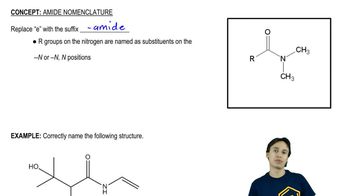
    A carboxylic acid derivative where the -OH group is replaced by a nitrogen atom, often with alkyl substituents.
  • Carboxylic Acid Derivative

    A compound structurally related to carboxylic acids, modified by replacing the hydroxyl group with another atom or group.
  • Parent Chain

    The longest continuous carbon chain containing the carbonyl group, serving as the base for naming.
  • Suffix

    A word ending, such as 'amide', added to the parent chain name to indicate functional group identity.
  • Substituent

    An atom or group, like an alkyl group, attached to the main structure, often specified in amide nomenclature.
  • Nitrogen

    An atom in amides capable of forming up to three bonds, allowing for multiple substituents.
  • Nomenclature

    A systematic method for naming chemical compounds, ensuring clarity and consistency in structure identification.
  • IUPAC Name

    A standardized chemical name assigned according to international rules, often used for precise identification.
  • Common Name

    A traditional or non-systematic name for a compound, sometimes used alongside IUPAC names.
  • Alkyl Group

    A hydrocarbon fragment, such as methyl or ethyl, that can be attached to the nitrogen in amides.
  • N,N-Substitution

    A naming convention indicating two identical groups attached to the nitrogen atom in an amide.
  • Locational Descriptor

    A number or Greek letter used to specify the position of a substituent on the parent chain.
  • Ester

    A carboxylic acid derivative where the -OH group is replaced by an -OR group, allowing only one substituent on oxygen.