Naming Amines quiz #1 Flashcards

Naming Amines quiz #1
Control buttons has been changed to "navigation" mode.
1/10
  • In which type of amine is the nitrogen atom bonded to two carbon atoms?
    In a secondary amine, the nitrogen atom is bonded to two carbon atoms (two alkyl or aryl groups) and one hydrogen.
  • What structural feature defines a compound as an amine?
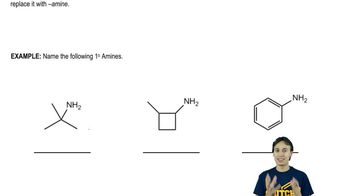
    A compound is classified as an amine if it contains a nitrogen atom bonded to one or more alkyl or aryl groups.
  • How can you identify amines among a set of molecules based on their structure?
    Amines can be identified by the presence of a nitrogen atom bonded to alkyl or aryl groups. Primary amines have one carbon group attached to nitrogen, secondary have two, and tertiary have three.
  • How is the structure of 4-amino-2-chlorophenol described according to IUPAC nomenclature?
    The structure of 4-amino-2-chlorophenol consists of a benzene ring with an amino group at position 4, a chloro group at position 2, and a hydroxyl group (phenol) at position 1.
  • How is the IUPAC name 'N-cyclohexyl-3-hexanamine' constructed, and what does it indicate about the structure?
    The name 'N-cyclohexyl-3-hexanamine' indicates a hexanamine chain with the amino group on carbon 3, and a cyclohexyl group attached directly to the nitrogen atom.
  • How do you write the common name for an amine based on its structure?
    The common name for an amine is typically formed by listing the alkyl groups attached to the nitrogen followed by 'amine.' For example, methylamine for CH3NH2, or dimethylamine for (CH3)2NH.
  • How do you classify amines as primary, secondary, or tertiary based on their structure?
    Amines are classified by the number of carbon-containing groups attached to the nitrogen: primary (one alkyl/aryl group), secondary (two), and tertiary (three).
  • What is the formal charge on the nitrogen atom in a quaternary amine and why does it occur?
    A quaternary amine always has a positive formal charge because the nitrogen atom forms four bonds, exceeding its usual valence. This results in the nitrogen carrying a positive charge due to the extra bond.
  • How do you modify the name of a primary amine when a higher priority functional group is present in the molecule?
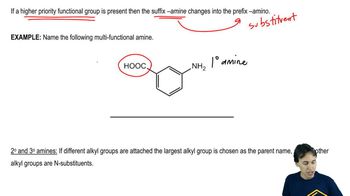
    When a higher priority functional group is present, the amine is named as a substituent using the prefix 'amino' instead of the suffix 'amine.' The main chain is named after the higher priority group, and the position of the amino group is indicated by a number.
  • What is the purpose of the 'N-' prefix in the nomenclature of secondary and tertiary amines?
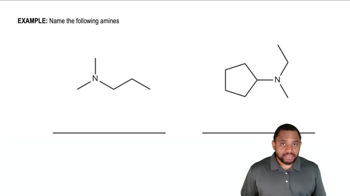
    The 'N-' prefix indicates that a substituent is attached directly to the nitrogen atom rather than to the carbon chain. This helps distinguish between groups on the nitrogen and those on the parent carbon chain.