Naming Carboxylic Acids quiz #1 Flashcards

Naming Carboxylic Acids quiz #1
Control buttons has been changed to "navigation" mode.
1/10
  • What are the common names for the first five straight-chain carboxylic acids, and how are they named in the IUPAC system?
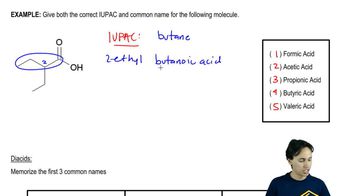
    The common names for the first five straight-chain carboxylic acids are: formic acid (1 carbon), acetic acid (2 carbons), propionic acid (3 carbons), butyric acid (4 carbons), and valeric acid (5 carbons). In the IUPAC system, these are named methanoic acid, ethanoic acid, propanoic acid, butanoic acid, and pentanoic acid, respectively.
  • Which carboxylic acid is required to synthesize isobutyl benzoate?
    To synthesize isobutyl benzoate, benzoic acid is required as the carboxylic acid component.
  • According to IUPAC guidelines, how do you name a carboxylic acid based on its alkane root?
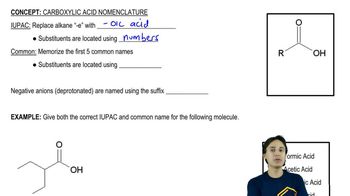
    In the IUPAC system, the name of a carboxylic acid is formed by replacing the 'e' at the end of the alkane root with 'oic acid.' For example, ethane becomes ethanoic acid. Substituents are indicated by numbers, such as 2-methylpropanoic acid for a methyl group on the second carbon of propanoic acid.
  • How are substituents indicated in the common naming system for carboxylic acids?
    In the common naming system, substituents are indicated using Greek letters such as alpha, beta, gamma, etc. The Greek letter corresponds to the carbon position relative to the carboxyl group.
  • What suffix is used for the anion form of a carboxylic acid in IUPAC nomenclature?
    The suffix 'ate' replaces 'oic acid' when naming the anion form of a carboxylic acid. For example, ethanoic acid becomes ethanoate when deprotonated.
  • Why do carboxylic acids have both common and IUPAC names?
    Carboxylic acids have both naming systems because they were studied and named before the IUPAC system was established in 1919. As a result, many traditional names are still widely used alongside systematic IUPAC names.
  • What is the maximum number of carbons for which you are typically expected to memorize the common names of straight-chain carboxylic acids?
    You are typically expected to memorize the common names for straight-chain carboxylic acids with up to five carbons. These are formic, acetic, propionic, butyric, and valeric acids.
  • How does the IUPAC system modify the alkane root to name a carboxylic acid?
    The IUPAC system replaces the 'e' at the end of the alkane root with 'oic acid' to name a carboxylic acid. For example, propane becomes propanoic acid.
  • What is the significance of Greek letters in the common naming system for carboxylic acids?
    Greek letters are used to indicate the position of substituents relative to the carboxyl group in the common naming system. Alpha is the carbon adjacent to the carboxyl group, followed by beta, gamma, etc.
  • What should you do if you encounter a carboxylic acid with an O negative charge in its structure?
    If a carboxylic acid has an O negative charge, you should use the 'ate' suffix instead of 'oic acid' in its name. This indicates the compound is in its anionic form.