What is the general structural feature that identifies a molecule as an ether?
An ether is identified by the functional group R-O-R, where two alkyl or aryl groups are bonded to an oxygen atom.
How can you recognize an ether among a set of organic molecules based on its structure?
An ether can be recognized by the presence of an oxygen atom bonded to two carbon-containing groups (R-O-R), with no hydrogen directly attached to the oxygen.
What is the common name of the ether with the structure CH3OCH2CH3?
The common name of CH3OCH2CH3 is methyl ethyl ether.
What is the IUPAC name for the ether with the structure CH3OCH2CH3?
The IUPAC name for CH3OCH2CH3 is 1-methoxyethane.
What is the common name for an ether with a phenyl group and a propyl group attached to oxygen?
The common name for an ether with a phenyl group and a propyl group attached to oxygen is phenyl propyl ether.
How would you draw the structure of phenyl propyl ether?
To draw phenyl propyl ether, connect a phenyl group (benzene ring) to an oxygen atom, and then connect the oxygen atom to a propyl group (three-carbon chain).
What is the common and IUPAC name for the ether with the formula CH3OCH2CH3?
The common name is methyl ethyl ether, and the IUPAC name is 1-methoxyethane.
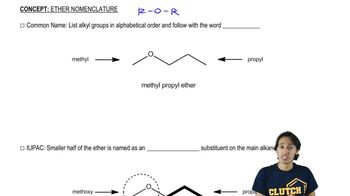
Why are common names often preferred over IUPAC names for simple ethers?
Common names are preferred because they are easier to use and remember for simple ethers. The common naming system simply lists the two R groups in alphabetical order followed by 'ether.'
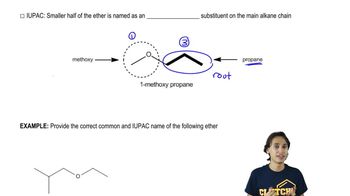
How is the root chain determined when assigning an IUPAC name to an ether?
The root chain is chosen as the larger of the two R groups attached to the oxygen atom. The smaller group is named as an alkoxy substituent on the root chain.
What does the term 'alkoxy' refer to in the context of IUPAC ether naming?
'Alkoxy' refers to an alkyl group attached to an oxygen atom, forming a substituent on the main carbon chain. The name is based on the number of carbons in the alkyl group, such as methoxy for one carbon or butoxy for four carbons.