Back

Negishi Coupling Reaction definitions

Control buttons has been changed to "navigation" mode.
1/14
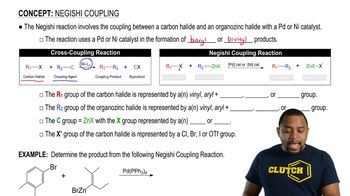
  • Negishi Coupling

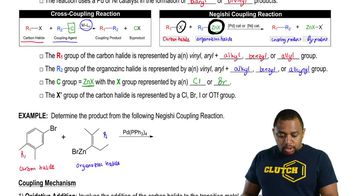
    A palladium- or nickel-catalyzed reaction joining a carbon halide and organozinc halide to form biaryl or bivinyl compounds.
  • Carbon Halide

    A molecule containing a carbon atom bonded to a halogen, serving as a key reactant in cross-coupling reactions.
  • Organozinc Halide

    A compound featuring a zinc atom bonded to an organic group and a halogen, acting as a coupling partner.
  • Palladium Catalyst

    A transition metal complex that facilitates bond formation and cleavage during the coupling process.
  • Nickel Catalyst

    A transition metal complex alternative to palladium, enabling similar coupling transformations.
  • Biaryl Product

    A molecule composed of two aromatic rings directly connected, often formed in coupling reactions.
  • Bivinyl Product

    A compound containing two vinyl groups joined together, resulting from specific coupling processes.
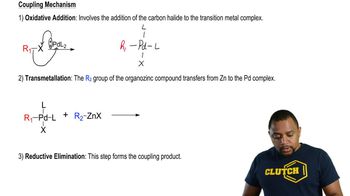
  • Oxidative Addition

    A step where a transition metal inserts into a carbon-halogen bond, increasing its oxidation state.
  • Transmetalation

    A process where an organic group transfers from zinc to the metal complex, exchanging partners with a halogen.
  • Reductive Elimination

    A step where two groups on a metal center combine and detach, forming the final product and regenerating the catalyst.
  • Transition Metal Complex

    A structure where a central metal atom is surrounded by ligands, crucial for catalytic activity.
  • Catalytic Cycle

    A sequence of steps that regenerates the catalyst, allowing continuous product formation.
  • 18 Electron Rule

    A guideline stating that transition metal complexes are most stable with 18 valence electrons.
  • Conjugated Product

    A molecule with alternating single and multiple bonds, resulting in enhanced stability.