What is a Newman projection and how is it used to visualize the conformations of butane?
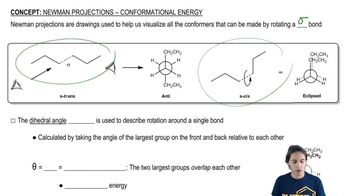
A Newman projection is a visualization technique in organic chemistry that shows the spatial arrangement of groups around a sigma bond by looking straight down the bond axis. For butane, the Newman projection helps compare different conformations (eclipsed, gauche, anti) by showing the relative positions of the methyl and hydrogen groups on adjacent carbons, allowing analysis of their stability and energy.
How can you convert a Newman projection into a wedge and dash structure for a simple alkane?
To convert a Newman projection into a wedge and dash structure, identify the groups attached to the front and back carbons in the projection. The front carbon's groups are drawn as coming out from the center, while the back carbon's groups are shown around the circle. In the wedge and dash structure, use solid wedges for bonds coming out of the plane, dashed wedges for bonds going behind the plane, and lines for bonds in the plane, matching the spatial arrangement shown in the Newman projection.
How do you represent a Newman projection for a given alkane, and what information does it convey?
A Newman projection for an alkane is represented by drawing a circle for the back carbon and a dot for the front carbon, with bonds radiating to the attached groups. It conveys the relative positions of substituents on adjacent carbons, allowing analysis of dihedral angles and conformational stability (eclipsed, gauche, anti).
How do you name a compound based on its Newman projection?
To name a compound from its Newman projection, identify the groups attached to the front and back carbons and reconstruct the carbon skeleton. Assign the longest continuous chain as the parent, number the carbons to give substituents the lowest possible numbers, and name the substituents accordingly.
How would you draw the Newman projection for 2,3-dimethylbutane?
To draw the Newman projection for 2,3-dimethylbutane, look down the bond between carbons 2 and 3. On the front carbon (C2), attach a methyl group, an ethyl group, and a hydrogen. On the back carbon (C3), attach a methyl group, an ethyl group, and a hydrogen. Arrange these groups around the front and back carbons in the projection to show their relative positions.
How can you determine whether a Newman projection is in the staggered or eclipsed conformation?
A Newman projection is staggered if the groups on the front carbon are positioned between the groups on the back carbon, maximizing separation. It is eclipsed if the groups on the front carbon directly overlap with the groups on the back carbon. Staggered conformations are more stable (lower energy), while eclipsed conformations are less stable (higher energy).
How would you draw the Newman projection for 2-methylbutane?
To draw the Newman projection for 2-methylbutane, look down the bond between carbons 2 and 3. On the front carbon (C2), attach a methyl group, an ethyl group, and a hydrogen. On the back carbon (C3), attach two hydrogens and a methyl group. Arrange these groups around the front and back carbons in the projection to show their relative positions.
What does the dihedral angle in a Newman projection represent and how does it affect molecular stability?
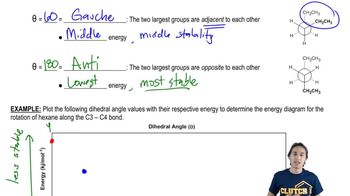
The dihedral angle is the angle between the two largest groups on adjacent carbons in a Newman projection. It determines the stability of the conformation, with 0° (eclipsed) being least stable, 60° (gauche) intermediate, and 180° (anti) most stable.
How does the energy of a molecule change as you rotate a sigma bond from 0 to 360 degrees in a Newman projection?
As you rotate the bond, the energy fluctuates, reaching maxima at eclipsed conformations (0°, 120°, 240°, 360°) and minima at anti conformations (180°). The energy diagram shows alternating peaks and valleys corresponding to these conformations.
Why do large groups in an eclipsed conformation result in higher energy compared to staggered conformations in a Newman projection?
Large groups in an eclipsed conformation experience greater electron repulsion because they are directly aligned, making the molecule less stable. In staggered conformations, the groups are farther apart, reducing repulsion and lowering the energy.