Skip to main content
Organic Chemistry
My Course
Learn
Exam Prep
AI Tutor
Study Guides
Textbook Solutions
Flashcards
Explore
Try the app
My Course
Learn
Exam Prep
AI Tutor
Study Guides
Textbook Solutions
Flashcards
Explore
Try the app
Back
Nitrogenous Nucleophiles definitions
You can tap to flip the card.
Primary Amine
You can tap to flip the card.
👆
Primary Amine
A compound featuring a nitrogen atom bonded to one alkyl group and two hydrogens, often synthesized via reduction of nitrogenous precursors.
Track progress
Control buttons has been changed to "navigation" mode.
1/15
Related flashcards
Related practice
Recommended videos
Nitrogenous Nucleophiles quiz
Nitrogenous Nucleophiles
15 Terms
Nitrogenous Nucleophiles
26. Amines
3 problems
Topic
Johnny
Reductive Amination
26. Amines
3 problems
Topic
Ernest
23. Amines - Part 1 of 3
4 topics
11 problems
Chapter
Nicole
23. Amines - Part 2 of 3
5 topics
13 problems
Chapter
Nicole
26. Amines - Part 3 of 3
1 topic
3 problems
Chapter
07:11
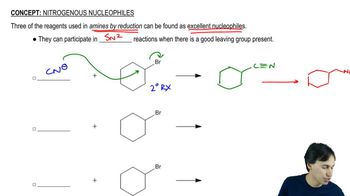
Four Ways to Make a Primary Amine Precursor
1661
views
8
rank
7
comments
01:30
Provide the Major Product
1502
views
11
rank
5
comments
Terms in this set (15)
Hide definitions
Primary Amine
A compound featuring a nitrogen atom bonded to one alkyl group and two hydrogens, often synthesized via reduction of nitrogenous precursors.
Nucleophilic Substitution
A reaction where a nucleophile replaces a leaving group on a carbon atom, commonly via backside attack in SN2 processes.
SN2 Reaction
A concerted mechanism involving simultaneous bond formation and breaking, characterized by inversion of configuration at the reactive center.
Alkyl Halide
An organic molecule containing a halogen atom attached to an sp3-hybridized carbon, serving as a substrate for nucleophilic attack.
Cyanide
A strong nucleophile with a carbon-nitrogen triple bond, used to introduce a nitrile group via substitution.
Nitrite
A nitrogen-oxygen anion acting as a nucleophile, capable of forming nitro groups through substitution reactions.
Azide
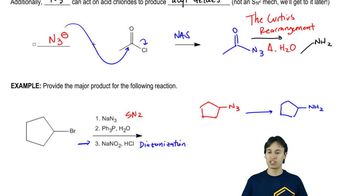
A linear anion with three nitrogen atoms, serving as a nucleophile to introduce azido groups or form acyl azides.
Leaving Group
An atom or group that departs with an electron pair during substitution, facilitating nucleophilic attack.
Nitrile
A functional group featuring a carbon triple-bonded to nitrogen, often reduced to yield primary amines.
Reduction
A process involving the gain of electrons or hydrogen, commonly used to convert nitrogenous groups into amines.
Tin(II) Chloride
A chemoselective reducing agent, especially effective for converting nitro groups to amines without affecting other functionalities.
Triphenylphosphine
A reagent used with water to reduce azides to amines, particularly when common reducing agents are ineffective.
Acyl Azide
A compound formed by nucleophilic acyl substitution, which can rearrange to amines upon heating.
Curtius Rearrangement
A thermal process converting acyl azides into amines, involving loss of nitrogen gas and migration of an alkyl group.
Nucleophilic Acyl Substitution
A mechanism where a nucleophile replaces a leaving group on a carbonyl carbon, forming new acyl derivatives.
 BackBack


 07:11
07:11