Back

NMR Integration definitions

Control buttons has been changed to "navigation" mode.
1/14
  • Integration

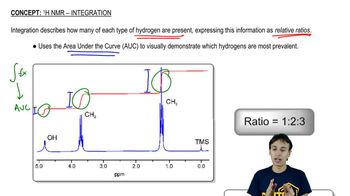
    Represents the relative quantities of hydrogen atoms by measuring the area under each NMR peak, not just the peak height.
  • Proton NMR

    A technique that reveals information about hydrogen environments in a molecule using magnetic resonance.
  • Area Under the Curve

    The total sum of all values beneath an NMR peak, used to determine the number of hydrogens present.
  • Relative Ratio

    A comparison of the quantities of different hydrogen types, often expressed as simple whole numbers.
  • Chemical Shift

    The position of an NMR signal along the spectrum, indicating the electronic environment of a hydrogen atom.
  • Splitting Pattern

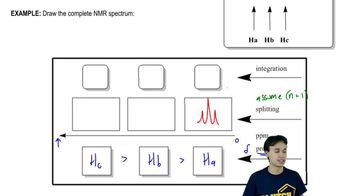
    The arrangement of multiple peaks for a single hydrogen type, caused by interactions with neighboring hydrogens.
  • n+1 Rule

    A guideline predicting the number of peaks in a splitting pattern based on adjacent hydrogens.
  • Pascal's Triangle

    A mathematical tool used to predict the relative intensities of peaks in splitting patterns.
  • Hydrogen Environment

    A unique chemical setting for a hydrogen atom, leading to distinct NMR signals.
  • PPM Line

    The axis on an NMR spectrum representing chemical shift values, typically increasing from right to left.
  • Integral Trace

    A stepped line above the NMR spectrum that visually represents the integration values for each signal.
  • Computer Calculation

    An automated process that determines integration values by summing the area under each NMR peak.
  • Hydrogen Isotope

    A variant of hydrogen, such as protium, detected and quantified in proton NMR experiments.
  • Spectrum

    A graphical output displaying the chemical shifts, splitting patterns, and integrations for all hydrogens in a sample.