Back

NMR Integration quiz

Control buttons has been changed to "navigation" mode.
1/15
  • What does integration in proton NMR describe?

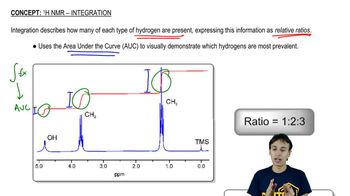
    Integration describes the relative quantities of different hydrogens (protons) present in a molecule.
  • Does the integration in NMR depend only on the height of the peak?

    No, integration depends on the area under the curve, which includes both the height and the width of the peak.
  • What mathematical concept is integration in NMR similar to?

    Integration in NMR is similar to taking the integral of a function, as in calculus (Riemann sums).
  • How are integration values typically determined in practice?

    Integration values are usually calculated by a computer, which sums the area under each peak.
  • How can integration values be expressed?

    Integration values can be expressed as ratios or as the number of protons (hydrogens) of each type.
  • If the integration ratio is 1:2:3, what does this tell you about the protons?

    It tells you that the protons are present in relative amounts of 1, 2, and 3 for each type, respectively.
  • Can the integration ratio correspond to more than one total number of protons?

    Yes, the ratio could represent any multiple (e.g., 6, 12, 18 protons) as long as the relative proportions are the same.
  • What three pieces of information are needed to draw an NMR spectrum?

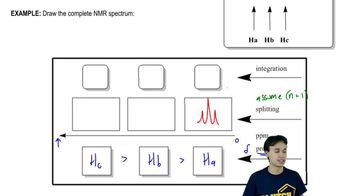
    You need the chemical shifts, splitting patterns, and integrations for each type of proton.
  • How do you determine the order of protons on the NMR spectrum?

    The order is determined by their chemical shifts, with more downfield protons appearing further to the left.
  • What rule is commonly used to predict splitting patterns in NMR?

    The n+1 rule is commonly used to predict splitting patterns.
  • What does an integration value of 3H mean?

    It means there are three hydrogens (protons) of that particular type in the molecule.
  • What does the area under the NMR peak represent?

    The area under the peak represents the relative number of protons contributing to that signal.
  • Why is it incorrect to use only peak height for integration?

    Because peak width also affects the area, and integration is based on the total area, not just height.
  • What is the purpose of the integration trace (red line) on an NMR spectrum?

    The integration trace visually shows the relative areas under each peak, corresponding to the number of protons.
  • If you are not told otherwise, which splitting rule should you assume for NMR problems?

    You should assume the n+1 rule for splitting unless instructed otherwise.