Back

NMR Spectroscopy definitions

Control buttons has been changed to "navigation" mode.
1/14
  • Nuclear Magnetic Resonance

    Analytical technique using magnetic fields to distinguish atomic nuclei in different electronic environments.
  • Proton NMR

    Instrumental method focusing on hydrogen atoms to reveal their unique electronic surroundings in molecules.
  • Spectrum

    Graphical output displaying signal positions and intensities, revealing details about atomic environments.
  • Parts Per Million

    Unit on the x-axis of the spectrum, standardizing chemical shift measurements for comparison.
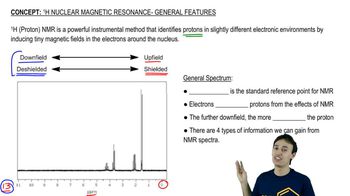
  • Downfield

    Region of the spectrum at higher ppm values, indicating protons with less electron shielding.
  • Upfield

    Region near zero ppm, representing protons with greater electron shielding.
  • Shielded

    Condition where electrons protect protons from the magnetic field, causing signals to appear upfield.
  • Deshielded

    State where fewer electrons surround protons, making them more exposed to the magnetic field and shifting signals downfield.
  • Tetramethylsilane

    Reference compound used to define zero ppm, known for its highly shielded protons.
  • Chemical Shift

    Position on the spectrum indicating how shielded or deshielded a proton is, measured in ppm.
  • Signal

    Distinct peak or set of peaks on the spectrum, each corresponding to a unique type of proton.
  • Multiplicity

    Pattern of peak splitting in a signal, revealing the number of neighboring protons.
  • Spin Splitting

    Division of a signal into multiple peaks due to interactions with adjacent protons.
  • Relative Ratio

    Proportional area under a signal, indicating the quantity of each proton type present.