Back

Nucleophiles and Basicity definitions

Control buttons has been changed to "navigation" mode.
1/15
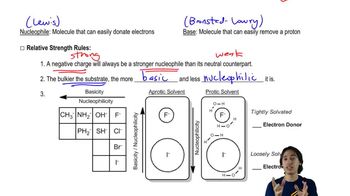
  • Nucleophile

    An electron-rich species that donates electrons to form a new chemical bond, often defined by the Lewis concept.
  • Base

    A substance that accepts protons, typically described by the Bronsted-Lowry definition in acid-base chemistry.
  • Nucleophilicity

    A measure of how readily a species donates electrons to an electrophile, influenced by charge, size, and solvent.
  • Basicity

    A measure of how strongly a species can accept a proton, often paralleling nucleophilicity but with key differences.
  • Electronegativity

    The tendency of an atom to attract electrons, with lower values generally increasing nucleophilicity and basicity.
  • Protic Solvent

    A solvent capable of hydrogen bonding, which can surround and stabilize charged species, affecting nucleophilicity trends.
  • Aprotic Solvent

    A solvent that cannot hydrogen bond, allowing nucleophilicity trends to follow atomic size and charge more directly.
  • Solvation

    The process where solvent molecules surround and interact with ions or molecules, impacting their reactivity.
  • Bulky Nucleophile

    A large, sterically hindered electron donor that is less effective at attacking electrophiles but often more basic.
  • Negative Charge

    An excess of electrons on a species, generally increasing its ability to donate electrons or accept protons.
  • Periodic Trend

    A predictable pattern in properties like nucleophilicity or basicity as one moves across or up the periodic table.
  • Hydrogen Bonding

    An interaction where a hydrogen atom is attracted to an electronegative atom, crucial in protic solvent effects.
  • Electron Donation

    The act of providing electrons to another species, central to nucleophilic behavior in reactions.
  • Proton Abstraction

    The removal of a proton from a molecule, a key action of bases in chemical reactions.
  • Steric Hindrance

    The restriction of reactivity due to the physical size of groups within a molecule, affecting nucleophilicity.