Back

Nucleophilic Addition definitions

Control buttons has been changed to "navigation" mode.
1/14
  • Nucleophilic Addition

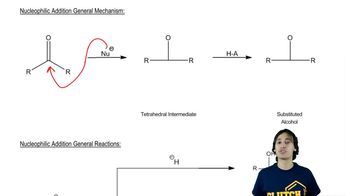
    A reaction where a nucleophile attacks an electrophilic carbon in a carbonyl, forming a tetrahedral intermediate and leading to a substituted alcohol.
  • Carbonyl Compound

    A molecule containing a carbon double-bonded to oxygen, making the carbon atom highly electrophilic and reactive toward nucleophiles.
  • Electrophilic Carbon

    A carbon atom in a carbonyl group that carries a partial positive charge, making it susceptible to attack by electron-rich species.
  • Nucleophile

    An electron-rich species, often negatively charged or with a lone pair, capable of donating electrons to an electrophilic center.
  • Tetrahedral Intermediate

    A transient structure formed when a nucleophile adds to a carbonyl carbon, resulting in four groups attached to the central carbon.
  • Protonation

    The process of adding a proton to a negatively charged oxygen in the intermediate, stabilizing the molecule and leading to the final product.
  • Substituted Alcohol

    A product of nucleophilic addition where an alcohol group is present along with an additional group introduced by the nucleophile.
  • Hydride

    A nucleophile represented as H−, which adds to a carbonyl, resulting in the reduction of the compound by introducing two hydrogens.
  • Reduction

    A reaction involving the addition of two hydrogens across a double bond, typically converting a carbonyl to an alcohol.
  • Cyanide

    A nucleophile with the formula CN−, which adds to a carbonyl, forming a substituted alcohol with a cyano group.
  • Alkynide

    A strong nucleophile and base derived from an alkyne, capable of attacking carbonyls and introducing a triple bond into the product.
  • Organometallic Compound

    A molecule containing a metal atom directly bonded to carbon, often used as a nucleophile in nucleophilic addition reactions.
  • Partial Positive Charge

    A slight positive character on the carbonyl carbon due to the electronegativity difference between carbon and oxygen.
  • Leaving Group

    An atom or group that departs with a pair of electrons during a reaction; in nucleophilic addition, R groups are poor at this role.