Back

Nucleophilic Addition quiz

Control buttons has been changed to "navigation" mode.
1/15
  • What is the key feature of the nucleophilic addition mechanism in carbonyl compounds?

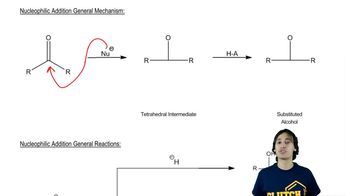
    A nucleophile attacks the electrophilic carbon of a carbonyl group, forming a tetrahedral intermediate.
  • Why is the carbonyl carbon considered electrophilic in nucleophilic addition reactions?

    Because the oxygen is more electronegative, it pulls electron density away, giving the carbon a partial positive charge.
  • What happens to the double bond between carbon and oxygen during nucleophilic addition?

    The double bond breaks, resulting in a negatively charged oxygen atom.
  • What is the name of the intermediate formed after a nucleophile attacks a carbonyl carbon?

    It is called a tetrahedral intermediate.
  • What is the final step in the nucleophilic addition mechanism?

    The negatively charged oxygen is protonated, usually by an acid, to form an alcohol.
  • What type of product is generally formed after nucleophilic addition to a carbonyl compound?

    A substituted alcohol is formed, where the nucleophile becomes a substituent.
  • What is the role of a nucleophile in the nucleophilic addition mechanism?

    The nucleophile donates electrons to the electrophilic carbon, initiating the reaction.
  • What happens if the nucleophile in nucleophilic addition is a hydride (H-)?

    Two hydrogens are added across the double bond, resulting in a reduction reaction.
  • What is the name of the reaction where two hydrogens are added across a double bond in a carbonyl compound?

    This reaction is called a reduction.
  • What is the result of using cyanide (CN-) as the nucleophile in nucleophilic addition?

    A substituted alcohol with a cyano group is formed.
  • What is an alkynide, and how does it act in nucleophilic addition?

    An alkynide is a strong nucleophile and base that adds a triple bond (C≡C) to the carbonyl carbon.
  • Why are R groups not typically kicked out during nucleophilic addition to a carbonyl?

    R groups are poor leaving groups and do not easily depart with a negative charge.
  • What is an organometallic compound, and how does it relate to nucleophilic addition?

    An organometallic compound contains a metal and carbon; it can act as a nucleophile in nucleophilic addition.
  • Why is the tetrahedral intermediate important in organic chemistry?

    It is a common intermediate in many reactions, especially in nucleophilic addition and will be seen often in advanced topics.
  • What determines the identity of the substituent on the final alcohol product in nucleophilic addition?

    The nature of the nucleophile used determines the substituent attached to the alcohol.