Nucleophilic Aromatic Substitution quiz #1 Flashcards

Nucleophilic Aromatic Substitution quiz #1
Control buttons has been changed to "navigation" mode.
1/10
  • Why is the nitro group considered a meta director in aromatic substitution reactions?
    The nitro group is a meta director because it is a strong electron-withdrawing group. When attached to a benzene ring, it withdraws electron density through both resonance and inductive effects, making the ortho and para positions less reactive toward electrophilic aromatic substitution. As a result, substitution occurs preferentially at the meta position, where the destabilizing effects of the nitro group are minimized.
  • What are the key features and requirements of nucleophilic aromatic substitution (SNAr) reactions?
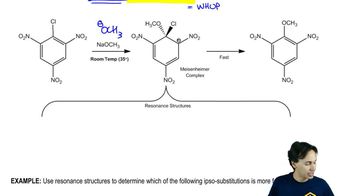
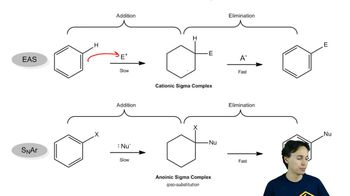
    Nucleophilic aromatic substitution (SNAr) requires a strong nucleophile and a good leaving group on the benzene ring. The reaction proceeds via a two-step addition-elimination mechanism, forming an anionic sigma complex intermediate. The process is facilitated by electron-withdrawing groups or heteroatoms in the ortho and para positions, which stabilize the intermediate through resonance. SNAr typically requires high heat and pressure unless the intermediate is stabilized, as in the Meisenheimer complex.
  • What is the key difference between the intermediates formed in EAS and SNAr mechanisms?
    EAS forms a cationic sigma complex with a positive charge, while SNAr forms an anionic sigma complex with a negative charge. The charge in each intermediate is delocalized through resonance.
  • Why does the Dow process for synthesizing phenol from chlorobenzene require high temperature and pressure?
    The Dow process requires harsh conditions because the anionic intermediate formed during SNAr is highly unstable. High temperature and pressure help drive the reaction forward despite this instability.
  • What is meant by 'ipso substitution' in the context of aromatic chemistry?
    Ipso substitution refers to a reaction where two groups temporarily share the same carbon atom during the intermediate stage. In SNAr, this term is used interchangeably with nucleophilic aromatic substitution.
  • How do electron-withdrawing groups in the ortho and para positions affect the SNAr reaction?
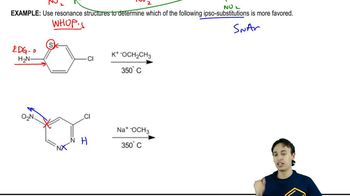
    Electron-withdrawing groups in these positions stabilize the negative charge of the anionic intermediate through resonance. This stabilization allows the reaction to proceed under milder conditions.
  • What role do heteroatoms play in stabilizing the Meisenheimer complex during SNAr?
    Heteroatoms, being more electronegative than carbon, help delocalize and stabilize the negative charge in the anionic intermediate. Their presence in the ring can lower the energy barrier for the reaction.
  • Why is the SNAr mechanism not considered a concerted process like SN2?
    SNAr proceeds through two distinct steps: addition of the nucleophile and elimination of the leaving group. Unlike SN2, which is a single concerted step, SNAr forms a discrete intermediate.
  • What is the significance of resonance structures in the SNAr mechanism?
    Resonance structures help distribute the negative charge over multiple atoms in the anionic intermediate. This delocalization increases the stability of the intermediate and facilitates the reaction.
  • How does the presence of a nitro group in the ortho or para position influence the temperature required for SNAr?
    A nitro group in these positions greatly stabilizes the anionic intermediate, allowing the reaction to occur at much lower temperatures. This is in contrast to reactions lacking such groups, which require high heat.