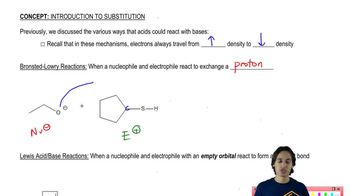
Which type of compound is least reactive toward nucleophilic addition-elimination reactions?
A compound with a poor leaving group or one that is less electrophilic is least reactive toward nucleophilic addition-elimination reactions, as the nucleophile has difficulty attacking and displacing the leaving group.
What is a substitution reaction in organic chemistry?
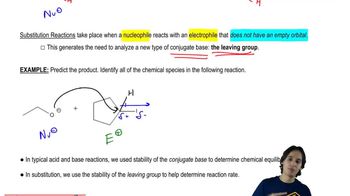
A substitution reaction is a process where a nucleophile donates electrons to an electrophile, resulting in the replacement of a leaving group by the nucleophile.
What is the general product of a nucleophilic substitution reaction?
The general product of a nucleophilic substitution reaction is a compound in which the nucleophile has replaced the leaving group on the electrophile.
How does the structure of an alkyl halide affect its reactivity in an E2 reaction with hydroxide ion?
In an E2 reaction, alkyl halides with more accessible β-hydrogens and less steric hindrance (such as primary alkyl halides) are generally more reactive with hydroxide ion.
Which type of alkyl halide reacts fastest with methanol in an SN1 mechanism?
Tertiary alkyl halides react fastest with methanol in an SN1 mechanism because they form the most stable carbocations.
What type of alcohol provides (S)-2-bromopentane upon reaction with PBr3?
The corresponding (S)-2-pentanol provides (S)-2-bromopentane upon reaction with PBr3, as the reaction proceeds with inversion of configuration.
Which type of carbocation intermediate is most likely to undergo rearrangement during reaction with methanol?
A carbocation intermediate that can become more stable through rearrangement, such as a secondary carbocation adjacent to a tertiary carbon, is most likely to undergo rearrangement during reaction with methanol.
Which type of alcohol is most likely to undergo substitution by an SN1 mechanism in acidic conditions?
A tertiary alcohol is most likely to undergo substitution by an SN1 mechanism in acidic conditions due to the stability of the resulting tertiary carbocation.
What is an example of a substitution reaction in organic chemistry?
An example of a substitution reaction is when a nucleophile replaces a leaving group on an electrophilic carbon, such as the reaction of an alkyl halide with a nucleophile.
How can you determine if a reaction is a nucleophilic substitution reaction?
A reaction is a nucleophilic substitution if a nucleophile attacks an electrophilic center, resulting in the replacement of a leaving group by the nucleophile.
What is the mechanism of a single-step bimolecular nucleophilic substitution (SN2) reaction?
In an SN2 reaction, the nucleophile attacks the electrophilic carbon at the same time as the leaving group departs, resulting in a single concerted step with inversion of configuration.
What is the general structure of the substitution product formed when a nucleophile reacts with an alkyl halide?
The substitution product has the nucleophile bonded to the carbon where the leaving group was originally attached.
How does pyridine react with hydroxide in a nucleophilic aromatic substitution?
Pyridine can undergo nucleophilic aromatic substitution with hydroxide, where the hydroxide attacks the aromatic ring, replacing a suitable leaving group.
What characterizes the transition state of an SN2 reaction?
The transition state of an SN2 reaction features the nucleophile partially bonded to the electrophilic carbon and the leaving group partially departing, with the carbon center adopting a pentavalent, trigonal bipyramidal geometry.
What happens when an acetylide ion reacts with methanol?
When an acetylide ion reacts with methanol, it acts as a strong base and can deprotonate methanol, resulting in the formation of an alkyne and methoxide ion.
How can a compound be prepared using an alkyl iodide and a suitable nucleophile?
A compound can be prepared by reacting an alkyl iodide with a nucleophile in a nucleophilic substitution reaction, where the nucleophile replaces the iodide leaving group.
 Back
Back

 05:55
05:55