What types of products are formed when an alkyne undergoes oxidative cleavage with hot potassium permanganate (KMnO4)?
Oxidative cleavage of an alkyne with hot KMnO4 breaks the triple bond, resulting in the formation of carboxylic acids from each carbon of the alkyne. If the alkyne is terminal (at the end of a chain), one product will be a carboxylic acid and the other will be carbon dioxide (from the single carbon fragment). If the alkyne is internal, two carboxylic acids are produced.
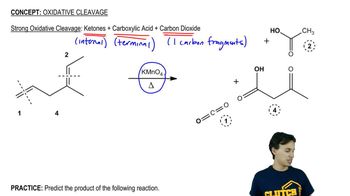
What determines whether a ketone or carboxylic acid is formed during oxidative cleavage of an alkene with hot KMnO4?
A ketone is formed if the double bond is internal with no hydrogens attached to the carbons, while a carboxylic acid is formed if there is at least one hydrogen on a terminal carbon. The presence or absence of hydrogens on the double-bonded carbons is key.
How does the number of hydrogens attached to a double-bonded carbon affect the product of oxidative cleavage?
Zero hydrogens leads to a ketone, one hydrogen leads to a carboxylic acid, and two hydrogens on a single carbon fragment result in carbon dioxide. The oxidation state increases with more hydrogens available for oxidation.
What happens to a cyclic alkene when it undergoes oxidative cleavage at one position?
Cutting a cyclic alkene at one position opens the ring and converts it into a straight chain. The molecule remains a single piece but changes shape.
Why is carbon dioxide considered the most oxidized form of carbon in oxidative cleavage reactions?
Carbon dioxide contains only carbon and oxygen, with no hydrogens, representing complete oxidation. It is classified as inorganic carbon because it lacks hydrogen atoms.
What is the difference in KMnO4’s reactivity with alkenes at cold versus hot temperatures?
Cold KMnO4 adds vicinal syn diols to the double bond, while hot KMnO4 cleaves the double bond completely. The temperature determines whether addition or cleavage occurs.
How does the geometry of a molecule affect the number of fragments produced during oxidative cleavage?
The number of cuts made determines the number of fragments; for example, cutting a ring once yields a single straight chain, while multiple cuts can produce several pieces. Geometric structure influences the outcome of the cleavage.
What is the general rule regarding R groups during oxidative cleavage of alkenes?
R groups attached to the double-bonded carbons remain in place during cleavage; only the double bond is broken. The products retain their original substituents except for the cleaved bond.
What type of product is formed when a one-carbon fragment is produced during oxidative cleavage?
A one-carbon fragment is fully oxidized to carbon dioxide. This occurs when the fragment has two hydrogens available for oxidation.
How does strong oxidative cleavage with hot KMnO4 relate to the concept of oxidation in organic chemistry?
Strong oxidative cleavage adds as many oxygens as possible to the fragments produced, increasing their oxidation state. The process exemplifies the addition of oxygen as a key aspect of oxidation.