Back

Oxidizing Agent definitions

Control buttons has been changed to "navigation" mode.
1/14
  • Oxidizing Agent

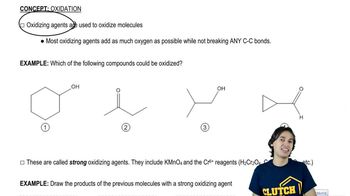
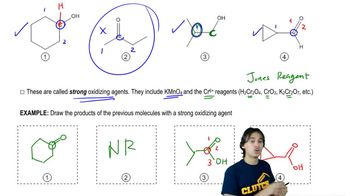
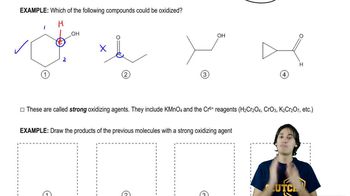
    A substance that increases the oxygen content of a molecule, typically without disrupting carbon-carbon bonds.
  • Jones' Reagent

    A mixture of chromium(VI) compound and strong acid, commonly used to convert secondary alcohols into ketones.
  • Chromic Acid

    A reactive species formed from chromium(VI) and acid, acting as a strong electrophile in oxidation reactions.
  • Secondary Alcohol

    A molecule where the hydroxyl group is attached to a carbon bonded to two other carbons, often oxidized to a ketone.
  • Ketone

    A compound featuring a carbonyl group bonded to two carbon atoms, often produced from secondary alcohol oxidation.
  • Nucleophilic Attack

    A step where an electron-rich atom donates electrons to an electron-poor center, initiating bond formation.
  • Alpha Elimination

    A process where a group is removed from the carbon directly attached to a functional group, forming a double bond to a non-carbon atom.
  • Electrophile

    A species with electron deficiency, making it susceptible to attack by electron-rich nucleophiles.
  • Protonation

    The addition of a hydrogen ion to a molecule, often stabilizing negative charges formed during reaction steps.
  • Deprotonation

    The removal of a hydrogen ion from a molecule, frequently facilitating the formation of double bonds.
  • Strong Acid

    A substance that fully dissociates in solution, often used to activate oxidizing agents like chromium(VI) compounds.
  • Carbon-Carbon Bond

    A linkage between two carbon atoms, typically preserved during most oxidation reactions except in special cases.
  • Ozonolysis

    A reaction where ozone cleaves carbon-carbon bonds, serving as an exception to the general oxidation rule.
  • Conjugate Base

    The species formed after an acid donates a proton, often involved in deprotonation steps during mechanisms.