Back

Ozonolysis quiz

Control buttons has been changed to "navigation" mode.
1/15
  • What type of reaction is ozonolysis classified as?

    Ozonolysis is classified as a weak oxidative cleavage reaction.
  • What is the main reagent used in ozonolysis?

    The main reagent used in ozonolysis is ozone (O3).
  • What types of products are typically formed from ozonolysis of alkenes?

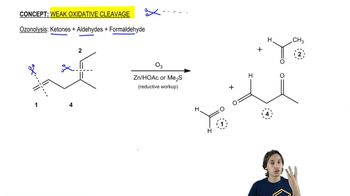
    Ozonolysis typically forms ketones, aldehydes, and formaldehyde.
  • What does the term 'cleavage' mean in the context of ozonolysis?

    In ozonolysis, 'cleavage' means cutting the carbon-carbon double bond to split the molecule into fragments.
  • How does ozonolysis affect the double bond in a carbon chain?

    Ozonolysis splits the double bond and adds oxygen atoms to both ends, forming carbonyl groups.
  • What determines the number and type of products formed in ozonolysis?

    The number of carbon atoms and the location of double bonds in the original chain determine the number and type of products.
  • What is the simplest aldehyde produced by ozonolysis, and what is its formula?

    The simplest aldehyde is formaldehyde, with the molecular formula CH2O.
  • What is the purpose of using zinc and acetic acid or dimethyl sulfide in ozonolysis?

    Zinc and acetic acid or dimethyl sulfide are used for the reductive workup, but they do not affect the final products.
  • What product is formed when a one-carbon chain is cleaved during ozonolysis?

    When a one-carbon chain is cleaved, formaldehyde (CH2O) is formed.
  • How can you visualize the process of ozonolysis to predict products?

    You can visualize ozonolysis by imagining cutting the carbon chain at double bonds and adding oxygen atoms to the ends.
  • What type of product is formed if the double bond is between two carbons with no hydrogens attached?

    A ketone is formed if the double bond is between two carbons with no hydrogens attached.
  • What type of product is formed if the double bond is at the end of a chain with a hydrogen attached?

    An aldehyde is formed if the double bond is at the end of a chain with a hydrogen attached.
  • Does the choice of reductive workup reagent affect the products of ozonolysis?

    No, the choice of reductive workup reagent does not affect the products of ozonolysis.
  • What happens to the hydrogens attached to the double bond carbons after ozonolysis?

    The hydrogens remain attached to the resulting carbonyl carbon after ozonolysis.
  • Why is practice with drawing ozonolysis products recommended?

    Practice helps students understand and apply the concept of ozonolysis in organic synthesis.