Ozonolysis quiz #1 Flashcards

Ozonolysis quiz #1
Control buttons has been changed to "navigation" mode.
1/10
  • What is the general structure of the starting material in an ozonolysis reaction, and how is it related to the products formed?
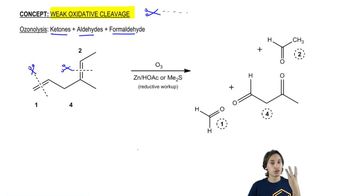
    The starting material in an ozonolysis reaction is an alkene, which contains a carbon-carbon double bond. During ozonolysis, this double bond is cleaved, and each carbon of the double bond becomes the carbonyl carbon of a new product, resulting in the formation of ketones, aldehydes, or formaldehyde depending on the substituents attached to the double-bonded carbons.
  • What types of products are formed when an alkene undergoes ozonolysis?
    Ozonolysis of an alkene produces carbonyl compounds, specifically ketones, aldehydes, and sometimes formaldehyde (CH2O) if a terminal carbon is involved. Each carbon of the original double bond becomes the carbonyl carbon in the product.
  • How can you determine the structure of an alkene that would yield specific carbonyl products via ozonolysis?
    To determine the structure of the original alkene from given ozonolysis products, identify the carbonyl groups in the products and conceptually 'join' them at the carbonyl carbons, replacing the carbonyl oxygens with a double bond between the two carbons. This reconstructs the original alkene.
  • Which types of compounds are not typically formed as products in an ozonolysis reaction of an alkene?
    Compounds that are not carbonyl-containing, such as alkanes, alcohols, or carboxylic acids (under standard reductive workup), are not typically formed as products in the ozonolysis of an alkene. The main products are ketones, aldehydes, and formaldehyde.
  • Describe the steps to predict the products of an ozonolysis reaction for a given alkene.
    To predict the products of ozonolysis: (1) Locate the carbon-carbon double bond in the alkene. (2) Conceptually 'cut' the double bond. (3) Add an oxygen atom to each carbon that was part of the double bond, converting them into carbonyl groups. (4) The resulting fragments are the products, which will be ketones, aldehydes, or formaldehyde depending on the structure of the original alkene.
  • What is the role of ozone (O3) in the ozonolysis reaction?
    Ozone acts as the reagent that cleaves the carbon-carbon double bond in alkenes. It adds oxygen atoms to both carbons of the double bond, forming carbonyl groups.
  • How does the geometry of the starting molecule affect the number of ozonolysis products formed?
    The number of products depends on how many places the double bond is cleaved and the structure of the molecule, such as whether it is a chain or a ring. Cutting a chain at one double bond yields two fragments, while cutting a ring at one point yields a single chain.
  • Why does formaldehyde (CH2O) often appear as a product in ozonolysis?
    Formaldehyde is produced when a one-carbon fragment is formed during the cleavage of the double bond. It is the simplest aldehyde, consisting of a carbonyl group bonded to two hydrogens.
  • Do the reagents used for reductive workup in ozonolysis affect the final products?
    No, the choice of reductive workup reagents, such as zinc and acetic acid or dimethyl sulfide, does not change the final products. Both yield the same carbonyl-containing compounds after ozonolysis.
  • What visual aid is suggested to help understand the process of ozonolysis?
    The use of 'scissors' is recommended as a visual aid to conceptualize the cleavage of carbon chains at the double bond. This helps students visualize how the molecule is split and how products are formed.