Pericyclic Reaction quiz #1 Flashcards

Pericyclic Reaction quiz #1
Control buttons has been changed to "navigation" mode.
1/10
  • What are the three main types of pericyclic reactions, and how can you distinguish between them based on the number of pi bonds destroyed during the reaction?
    The three main types of pericyclic reactions are cycloadditions, electrocyclic reactions, and sigmatropic shifts. Cycloadditions destroy two pi bonds, electrocyclic reactions destroy one pi bond, and sigmatropic shifts do not destroy any pi bonds but involve a rearrangement of their positions.
  • Why do solvents have no effect on the rate of pericyclic reactions?
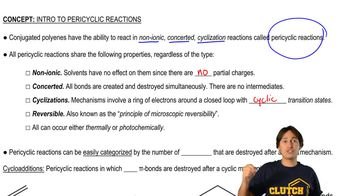
    Pericyclic reactions do not involve ions or partial charges, so there is nothing for the solvent to stabilize. As a result, solvents do not influence the reaction rate.
  • What does it mean for a pericyclic reaction to be concerted?
    A concerted reaction means all bonds are formed and broken simultaneously in a single step. There are no intermediates, only a transition state.
  • How are pericyclic reactions typically activated?
    Pericyclic reactions can be activated either thermally by heat or photochemically by light. Both methods initiate the cyclic mechanism.
  • What is the principle of microscopic reversibility in the context of pericyclic reactions?
    It means that pericyclic reactions are reversible and can proceed from reactants to products and vice versa under suitable conditions. This is represented by equilibrium arrows in reaction schemes.
  • What is a cyclic transition state in pericyclic reactions?
    A cyclic transition state involves a ring of electrons moving in a closed loop during the reaction. This is a hallmark of pericyclic mechanisms.
  • How can you identify a sigmatropic shift based on the number of pi bonds before and after the reaction?
    A sigmatropic shift is identified when the number of pi bonds remains unchanged after the reaction. The pi bonds only change their positions, not their quantity.
  • Why are pericyclic reactions considered non-ionic?
    They do not involve electron donors or acceptors that create ions or partial charges. This distinguishes them from many other organic reactions.
  • What is the significance of using equilibrium arrows in pericyclic reaction mechanisms?
    Equilibrium arrows indicate that the reaction is reversible and can proceed in both directions. This reflects the principle of microscopic reversibility.
  • How can the alphabetical order of cycloaddition, electrocyclic, and sigmatropic shift help in memorizing their properties?
    The alphabetical order corresponds to the number of pi bonds destroyed: cycloaddition (2), electrocyclic (1), and sigmatropic shift (0). This makes it easier to recall their differences.