pKa quiz #1 Flashcards

pKa quiz #1
Control buttons has been changed to "navigation" mode.
1/10
  • What is the pKa value of acetic acid, and how does it compare to other carboxylic acids?
    The pKa value of acetic acid is approximately 4.75, which is typical for carboxylic acids that generally have pKa values around 5. This indicates that acetic acid is a relatively strong acid compared to other organic compounds.
  • Estimate the pKa values for the following types of compounds: alkanes, alkenes, alkynes, amines, diatomic hydrogen (H2), alpha hydrogens adjacent to a carbonyl, alcohols/water, positively charged nitrogen compounds, carboxylic acids, and strong mineral acids.
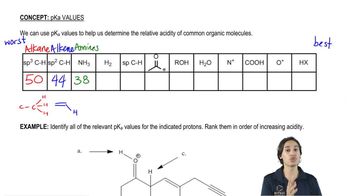
    Approximate pKa values for common organic compounds are: alkanes (sp3 C-H): ~50; alkenes (sp2 C-H): ~44; alkynes (sp C-H): ~25; amines: ~38; diatomic hydrogen (H2): ~35; alpha hydrogens adjacent to a carbonyl: ~20; alcohols and water: ~16; positively charged nitrogen compounds: ~10; carboxylic acids: ~5; strong mineral acids (e.g., HCl, HBr, HI): negative pKa values.
  • Why do alkanes have such high pKa values compared to other organic compounds?
    Alkanes have high pKa values (around 50) because they lack reactive features like dipoles, charges, or double bonds. This makes them very poor acids.
  • What structural feature distinguishes an alkene from an alkane in terms of acidity?
    An alkene contains a double bond, making it sp2 hybridized, while an alkane is sp3 hybridized with only single bonds. The double bond in alkenes increases their reactivity and slightly lowers their pKa compared to alkanes.
  • How does the presence of a carbonyl group affect the acidity of adjacent hydrogens?
    A carbonyl group increases the acidity of adjacent (alpha) hydrogens, lowering their pKa to around 20. This is due to a phenomenon called tautomerization, which stabilizes the conjugate base.
  • What is the significance of water's pKa value in the context of organic acid strength?
    Water's pKa of about 16 serves as a midpoint for comparing acid strengths in organic chemistry. Acids with lower pKa values are considered stronger than water, while those with higher values are weaker.
  • Why are positively charged nitrogen compounds considered stronger acids than neutral amines?
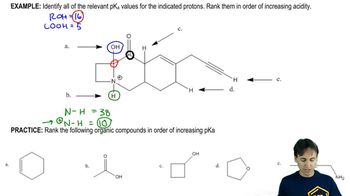
    Positively charged nitrogen compounds have a pKa around 10 due to their high electrophilicity from the formal positive charge. This makes them much better at donating protons than neutral amines, which have a pKa around 38.
  • What general trend is observed in acidity as you move from alkanes to alkynes?
    Acidity increases as you move from alkanes (sp3, pKa ~50) to alkenes (sp2, pKa ~44) to alkynes (sp, pKa ~25). This trend is due to increasing s-character and bond reactivity.
  • How are strong mineral acids like HCl, HBr, and HI typically represented in terms of pKa values?
    Strong mineral acids such as HCl, HBr, and HI are grouped together as having negative pKa values. This indicates they are extremely strong acids.
  • What is the recommended approach for students regarding memorization of pKa values in organic chemistry?
    Students are advised to memorize key pKa values even if they do not fully understand the underlying reasons. This memorization is crucial for success in organic chemistry courses and exams.