In a free radical bromination reaction, which hydrogen atom in an organic molecule is most easily abstracted by a bromine radical?
The hydrogen atom most easily abstracted in a free radical bromination reaction is the one attached to the carbon that forms the most stable radical after abstraction. Typically, this is a tertiary hydrogen (attached to a tertiary carbon), followed by secondary and then primary hydrogens, because tertiary radicals are more stabilized by hyperconjugation and alkyl group electron donation.
What factors determine which hydrogen atom in a molecule will be most readily abstracted by a bromine radical during a radical reaction?
The most readily abstracted hydrogen atom is the one whose removal leads to the most stable carbon radical. Radical stability increases in the order: tertiary > secondary > primary. Therefore, hydrogens attached to tertiary carbons are most readily abstracted, followed by those on secondary and then primary carbons.
Describe the process of homolytic cleavage in the initiation step of a radical reaction and explain its significance.
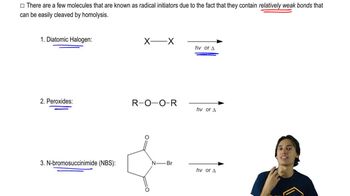
Homolytic cleavage is the process where a bond breaks and each atom takes one electron, forming two radicals. In the initiation step of a radical reaction, this typically occurs in molecules with weak bonds (such as diatomic halogens, peroxides, or N-bromosuccinimide) under heat or light. This step is significant because it generates the first radicals needed to propagate the radical reaction mechanism.
What is the main difference in electron movement between heterolytic and homolytic bond cleavage?
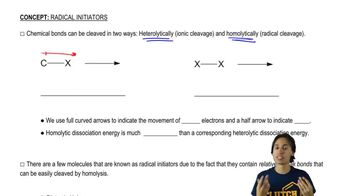
In heterolytic cleavage, both electrons from the bond move to one atom, while in homolytic cleavage, each atom receives one electron. This results in ions for heterolytic cleavage and radicals for homolytic cleavage.
Why is homolytic cleavage less common than heterolytic cleavage in organic reactions?
Homolytic cleavage usually requires more energy than heterolytic cleavage because it is harder to split a bond so that each atom gets one electron. Therefore, most organic reactions favor heterolytic cleavage unless specific conditions or initiators are present.
What type of arrow is used to represent the movement of a single electron in radical mechanisms?
A half-headed arrow, also called a fish hook arrow, is used to show the movement of a single electron. This distinguishes it from the full-headed arrow used for two-electron movements.
What role does heat or light play in the initiation step of radical reactions?
Heat or light provides the energy needed to break weak bonds homolytically in radical initiators. This energy excites the electrons, allowing them to split evenly and form radicals.
Which bond in peroxides is responsible for their ability to act as radical initiators?
The weak O–O bond in peroxides is responsible for their ability to undergo homolytic cleavage. When this bond breaks, it generates two radical species that can initiate radical reactions.
What is the significance of N-bromosuccinimide (NBS) in radical reactions?
NBS serves as a source of bromine radicals due to its relatively weak N–Br bond. In the presence of heat or light, it generates Br radicals that can participate in radical mechanisms.
Why is it important to recognize both the full name and acronym of N-bromosuccinimide in organic chemistry?
Professors may refer to N-bromosuccinimide as either its full name or the acronym NBS, and may also test recognition of its structure. Being familiar with all forms ensures you can identify it in different contexts during exams.