Ranking Acidity quiz #1 Flashcards

Ranking Acidity quiz #1
Control buttons has been changed to "navigation" mode.
1/35
  • What factors should you consider when determining which molecule has the most acidic hydrogen atoms?
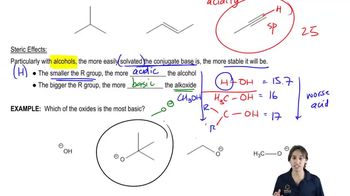
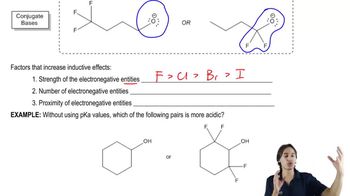
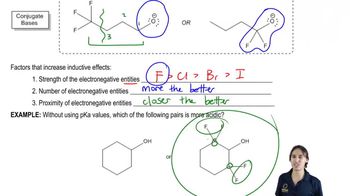
    Consider the stability of the conjugate base, including element effects (electronegativity and atomic size), inductive effects, resonance effects, hybridization, and steric effects.
  • How can you determine which carboxylic acid is the most acidic without pKa values?
    Compare the stability of the conjugate bases using factors such as resonance, inductive effects from substituents, and the presence of electron-withdrawing groups near the carboxyl group.
  • How do you identify the most acidic proton in a compound?
    Identify the hydrogen whose removal leads to the most stable conjugate base, considering resonance, inductive effects, and the atom to which the hydrogen is attached.
  • How do you determine which substituent has the highest priority when ranking acidity?
    The substituent that most stabilizes the conjugate base, typically through strong electron-withdrawing inductive or resonance effects, has the highest priority in increasing acidity.
  • How do you determine which highlighted hydrogen atom in a molecule is the most acidic?
    The most acidic hydrogen is the one whose removal results in the most stabilized conjugate base, often due to resonance, inductive effects, or attachment to a more electronegative or larger atom.
  • How do you determine which of four compounds is the most acidic?
    Compare the stability of each compound's conjugate base using element effects, inductive effects, resonance, hybridization, and steric effects to identify the most acidic compound.
  • How do you rank hydrogens in bold in order of increasing acidity?
    Rank the hydrogens by evaluating the stability of the conjugate base formed after deprotonation, considering resonance, inductive effects, and the atom to which each hydrogen is attached.
  • How do you rank compounds in order of decreasing acidity?
    List the compounds from the one with the most stabilized conjugate base (most acidic) to the least stabilized (least acidic), considering all acidity factors.
  • How do you rank compounds in order of increasing acidity?
    Arrange the compounds from the one with the least stable conjugate base (least acidic) to the one with the most stable conjugate base (most acidic), using the five acidity factors.
  • How do you determine which compound is most acidic among several options?
    Identify the compound whose conjugate base is most stabilized by element effects, inductive effects, resonance, hybridization, or minimal steric hindrance.
  • How do you rank acids from lowest pKa to highest pKa?
    Arrange the acids from most acidic (lowest pKa) to least acidic (highest pKa) by evaluating the stability of their conjugate bases.
  • How do you compare the relative acidities of given compounds?
    Assess the stability of each compound's conjugate base using the five acidity factors and rank them accordingly.
  • How do you arrange acids from lowest pKa to highest pKa?
    Order the acids from most acidic (lowest pKa) to least acidic (highest pKa) based on the stabilization of their conjugate bases.
  • How do you rank compounds in order of increasing acidity?
    List the compounds from least acidic to most acidic by comparing the stability of their conjugate bases using the five acidity factors.
  • How do you rank structures in order of decreasing electrophile strength?
    Rank structures from most to least electrophilic by considering the presence of electron-withdrawing groups and the ability to stabilize positive charge.
  • How do you arrange compounds in order of increasing acidity?
    Arrange the compounds from least to most acidic by evaluating the stabilization of their conjugate bases through element, inductive, resonance, hybridization, and steric effects.
  • How do you rank compounds in order of increasing acidity?
    Order the compounds from least acidic to most acidic by considering the factors that stabilize the conjugate base.
  • How do you rank solutions in order of increasing acidity?
    Rank the solutions from least to most acidic by comparing the acid strengths of the solutes, based on the stability of their conjugate bases.
  • How do you rank compounds in order of decreasing acidity?
    List the compounds from most acidic to least acidic by evaluating the stabilization of their conjugate bases.
  • How do you arrange compounds based on their relative Brønsted acidities?
    Rank the compounds from strongest to weakest Brønsted acid by assessing the stability of their conjugate bases.
  • How do you rank compounds from most acidic to least acidic?
    Order the compounds from the one with the most stabilized conjugate base (most acidic) to the least stabilized (least acidic).
  • How do you rank compounds in order of decreasing base strength?
    List the compounds from strongest to weakest base by considering the least stabilized conjugate base as the strongest base.
  • How do you arrange compounds in order of decreasing pKa, highest first?
    Order the compounds from least acidic (highest pKa) to most acidic (lowest pKa) by evaluating the stability of their conjugate bases.
  • How do you arrange compounds in order of increasing acidity?
    Arrange the compounds from least to most acidic by comparing the stabilization of their conjugate bases.
  • How do you rank bold-faced hydrogens in compounds from most acidic to least acidic?
    Rank the hydrogens by the stability of the conjugate base formed after deprotonation, considering resonance, inductive effects, and the atom to which each hydrogen is attached.
  • How do you rank structures in order of increasing basicity?
    List the structures from least to most basic by considering the stability of the conjugate acid; the less stable the conjugate acid, the stronger the base.
  • How do you compare the relative acidities of given compounds?
    Assess the stability of each compound's conjugate base using the five acidity factors and rank them accordingly.
  • How do you identify the most acidic hydrogen in a compound?
    The most acidic hydrogen is the one whose removal leads to the most stabilized conjugate base, often due to resonance, inductive effects, or attachment to a more electronegative or larger atom.
  • How do you rank compounds in decreasing order of acidity?
    List the compounds from most acidic to least acidic by evaluating the stabilization of their conjugate bases.
  • How do you determine which compound is most acidic among several options?
    Identify the compound whose conjugate base is most stabilized by element effects, inductive effects, resonance, hybridization, or minimal steric hindrance.
  • How do you identify the most acidic proton in a compound?
    The most acidic proton is the one whose removal results in the most stabilized conjugate base, considering resonance, inductive effects, and the atom to which the hydrogen is attached.
  • How do you determine which compound is the most acidic among several choices?
    The most acidic compound is the one whose conjugate base is most stabilized by resonance, inductive effects, element effects, hybridization, or minimal steric hindrance.
  • How do you rank compounds in order of increasing acidity?
    Arrange the compounds from least to most acidic by evaluating the stabilization of their conjugate bases using the five acidity factors.
  • How do you select the most acidic type of hydrogen in a molecule?
    Choose the hydrogen whose removal leads to the most stabilized conjugate base, often due to resonance, inductive effects, or attachment to a more electronegative or larger atom.
  • How do you determine which indicated proton in a molecule is most acidic?
    The most acidic indicated proton is the one whose removal results in the most stabilized conjugate base, considering resonance, inductive effects, and the atom to which the hydrogen is attached.