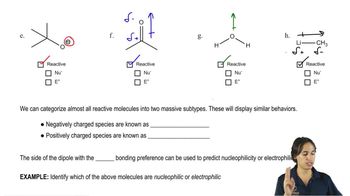
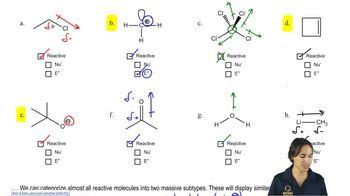
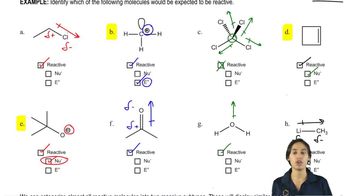
Describe the general steps involved in an organic reaction mechanism and identify the major product and reaction type based on nucleophile and electrophile interactions.
An organic reaction mechanism involves the movement of electrons from a nucleophile (electron-rich species) to an electrophile (electron-poor species), typically illustrated with curved arrows. The major product is formed by the creation of new bonds where the nucleophile attacks the electrophile. The reaction type can be classified based on whether it involves nucleophilic substitution, elimination, addition, or acid-base processes.
What is the minimum number of steps that a reaction mechanism must have in organic chemistry?
A reaction mechanism must have at least one step, which involves the movement of electrons from a nucleophile to an electrophile.
How is the molecularity of a step in a proposed reaction mechanism determined?
The molecularity of a step is determined by counting the number of reactant species involved in that elementary step. If one molecule is involved, it is unimolecular; if two, bimolecular.
How do you determine the major product and likely mechanism for a reaction involving nucleophiles and electrophiles?
The major product is determined by identifying the nucleophile and electrophile, then following the electron flow from the nucleophile to the electrophile to form new bonds. The likely mechanism depends on the nature of the reactants and conditions, such as nucleophilic substitution or elimination.
What type of intermediate is commonly formed during the bromination of an alkene such as propene?
During the bromination of an alkene like propene, a bromonium ion intermediate is commonly formed.
How are organic reactions classified based on the movement of electrons and the types of species involved?
Organic reactions are classified based on whether they involve nucleophiles attacking electrophiles (nucleophilic substitution or addition), elimination of groups, or acid-base interactions.
What is the most likely mechanism for a reaction between a nucleophile and an electrophile?
The most likely mechanism is that the nucleophile donates a pair of electrons to the electrophile, forming a new bond, typically illustrated with a curved arrow from the nucleophile to the electrophile.
In a reaction mechanism, what does the structure at the arrow typically represent?
The structure at the arrow typically represents an intermediate or transition state formed during the reaction as electrons move from the nucleophile to the electrophile.
What is a common mistake that violates the rules for drawing curved arrows in organic mechanisms?
A common mistake is drawing a curved arrow that starts from an electron-poor region (electrophile) instead of from an electron-rich region (nucleophile), or drawing arrows that do not preserve the octet rule.
How can you determine which reaction mechanism is consistent with a given reaction profile showing intermediates and transition states?
A reaction mechanism is consistent with a reaction profile if the number and type of intermediates and transition states match the steps and intermediates proposed in the mechanism.
At what point do the SN1 and E1 mechanisms diverge in their reaction pathways?
The SN1 and E1 mechanisms diverge after the formation of the carbocation intermediate; SN1 proceeds with nucleophilic attack, while E1 proceeds with elimination to form a double bond.
How do you determine whether an E1 or E2 mechanism will occur in a given reaction?
The mechanism depends on the substrate, base strength, and reaction conditions. E1 occurs with weak bases and stable carbocations, while E2 occurs with strong bases and requires a single concerted step.
How do you use curved arrows to show the movement of electrons in an organic reaction mechanism?
Curved arrows are drawn from regions of high electron density (nucleophile or lone pairs) to regions of low electron density (electrophile or atom being attacked), indicating the movement of electron pairs.
How do you complete the mechanism for an acid-base reaction using curved arrows?
Draw a curved arrow from the lone pair on the base to the hydrogen atom of the acid, and another arrow from the bond between hydrogen and the acid to the atom that will accept the electrons, showing proton transfer.
How do you use curved arrows to show the forming and breaking of bonds in a reaction mechanism?
Draw a curved arrow from the electron-rich site (nucleophile) to the atom being attacked (electrophile) to show bond formation, and if necessary, another arrow from the bond being broken to the atom that will take the electrons, to show bond breaking.
How do you draw step 1 of a reaction mechanism using curved arrows?
In step 1, identify the nucleophile and electrophile, then draw a curved arrow from the nucleophile's electron pair to the electrophilic center to indicate bond formation.
How do you predict the major organic product of a reaction and outline its mechanism?
Identify the nucleophile and electrophile, use curved arrows to show electron movement, and determine the product formed by the new bonds created. The major product is typically the most stable or favored by the reaction conditions.
How do you identify intermediates in a reaction profile diagram?
Intermediates are species that exist at local energy minima between transition states in a reaction profile, representing stable or semi-stable structures formed during the reaction.
How do you add curved arrows to the reactant side of an SN1 mechanism?
Draw a curved arrow from the leaving group bond to the leaving group to show its departure, forming a carbocation intermediate.
How do you use curved arrows to illustrate the first step of a reaction mechanism?
Draw a curved arrow from the nucleophile's electron pair to the electrophilic atom, indicating the initial bond-forming event.
How do you use curved arrows to draw step 2 of a reaction mechanism?
In step 2, identify the next electron-rich site and the atom to be attacked, then draw a curved arrow from the electron-rich site to the electrophilic center, and if necessary, another arrow to show bond breaking.
How do you identify compounds in a reaction scheme based on their roles as nucleophiles, electrophiles, or intermediates?
Identify each compound by analyzing its structure for electron-rich (nucleophile) or electron-poor (electrophile) regions, and recognize intermediates as species formed between steps.
How do you determine the kinetic product formed during a reaction?
The kinetic product is the product that forms fastest, typically via the lowest activation energy pathway, and is often less stable than the thermodynamic product.
How do you complete step 1 of a reaction mechanism by adding any remaining curved arrows?
Ensure all electron movements are accounted for by drawing curved arrows from electron-rich sites to electron-poor sites, and from bonds being broken to the appropriate atoms.
How do you draw the mechanism arrows for the acid-catalyzed hydrolysis of an acetal back to an aldehyde?
Draw curved arrows to show protonation of the acetal oxygen, nucleophilic attack by water, and subsequent bond breaking to regenerate the aldehyde.
How do you draw a mechanism that explains the formation of a particular regiochemistry in a reaction?
Show the movement of electrons using curved arrows to indicate how the nucleophile attacks the electrophile, leading to the observed regiochemistry based on stability and electron flow.
How do you complete the mechanism for the cleavage of an ether by adding the missing curved arrows?
Draw curved arrows to show protonation of the ether oxygen, followed by bond breaking to generate the appropriate products.
How do you identify a mechanistic step in a radical halogenation reaction?
A mechanistic step in radical halogenation involves homolytic bond cleavage, shown by half-headed arrows indicating the movement of single electrons to form radicals.
How do you select the preferred substitution mechanism (SN1 or SN2) for a given structure?
The preferred substitution mechanism depends on the substrate structure, leaving group, and nucleophile strength. SN1 is favored by stable carbocations and weak nucleophiles; SN2 is favored by strong nucleophiles and less hindered substrates.
How do you determine the likely mechanism for a given organic reaction?
Analyze the reactants and conditions to determine if the reaction proceeds via nucleophilic substitution, elimination, addition, or acid-base mechanism, based on the nature of the nucleophile, electrophile, and leaving group.
How do you draw the major organic product(s) for a reaction without including inorganic byproducts?
Identify the organic reactants, follow the mechanism to determine the new bonds formed, and draw the resulting organic product(s) only.
How do you draw a mechanism for a given organic reaction?
Identify the nucleophile and electrophile, then use curved arrows to show the movement of electrons from the nucleophile to the electrophile, indicating bond formation and breaking as needed.
How do you draw the expected major elimination product and identify the mechanism involved?
Identify the base and the leaving group, use curved arrows to show proton abstraction and leaving group departure, and draw the resulting alkene as the major elimination product. The mechanism is E1 or E2 depending on the conditions.
How do you add any remaining curved arrows to complete a reaction mechanism?
Review the mechanism to ensure all electron movements are shown, adding curved arrows from electron-rich to electron-poor sites and from bonds being broken to the appropriate atoms.
How do you determine the structure of a molecule based on its reactivity and the presence of nucleophilic or electrophilic sites?
Analyze the molecule for formal charges, net dipoles, pi bonds, and steric effects to identify reactive sites, then deduce the structure based on likely nucleophilic or electrophilic behavior.
How do you draw a mechanism for a given organic transformation?
Identify the starting materials and products, then use curved arrows to show the stepwise movement of electrons from nucleophiles to electrophiles, indicating bond formation and breaking.
How are curved arrows used to illustrate the flow of electrons in a reaction under specific conditions?
Curved arrows are drawn from electron-rich regions (such as lone pairs or pi bonds) to electron-poor regions (such as carbocations or electrophilic atoms) to show the flow of electrons during the reaction.
How do you draw a mechanism for a specific organic reaction?
Identify the nucleophile and electrophile, then use curved arrows to show the movement of electrons, indicating each step of bond formation and breaking until the product is formed.
How do you use curved arrows to complete the mechanism of the sulfonation of benzene?
Draw curved arrows to show the attack of benzene's pi electrons on the electrophilic sulfur atom, followed by proton loss to regenerate aromaticity.
Describe the two-step mechanism for the conversion of acetyl chloride to methyl acetate.
Step 1: Nucleophilic attack by methanol on the carbonyl carbon of acetyl chloride, forming a tetrahedral intermediate. Step 2: Elimination of chloride ion and proton transfer to yield methyl acetate.