Back

Reducing Agent definitions

Control buttons has been changed to "navigation" mode.
1/15
  • Reduction

    Process that increases hydrogen content in a molecule, often by adding hydrogens across pi bonds, leading to greater saturation.
  • Reducing Agent

    Substance that donates hydride ions to other molecules, facilitating the addition of hydrogen and conversion of functional groups.
  • Hydride Ion

    Nucleophilic species with a negative charge, responsible for attacking electrophilic carbons in carbonyl groups during reduction.
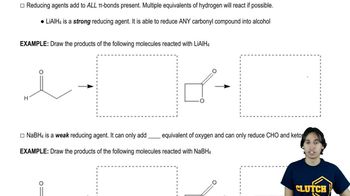
  • Lithium Aluminum Hydride

    Powerful reagent capable of reducing nearly all carbonyl compounds, including esters and carboxylic acids, to alcohols.
  • Sodium Borohydride

    Milder reagent that selectively reduces aldehydes and ketones but is ineffective against esters, carboxylic acids, and amides.
  • Nucleophilic Addition

    Mechanism where a nucleophile attacks an electrophilic carbon, commonly seen when hydride ions add to carbonyl carbons.
  • Carbonyl Group

    Functional group featuring a carbon double-bonded to oxygen, serving as a key site for reduction reactions.
  • Alcohol

    Product formed when a carbonyl group is reduced, characterized by a hydroxyl group attached to a saturated carbon.
  • Aldehyde

    Carbonyl-containing compound with a hydrogen atom bonded to the carbonyl carbon, readily reduced to a primary alcohol.
  • Ketone

    Carbonyl-containing compound with two carbon groups attached to the carbonyl carbon, reduced to a secondary alcohol.
  • Ester

    Functional group with a carbonyl bonded to an oxygen atom, which can be cleaved and reduced to alcohols by strong agents.
  • Carboxylic Acid

    Highly oxidized functional group with a carbonyl and hydroxyl on the same carbon, resistant to reduction by mild agents.
  • Amide

    Functional group with a carbonyl bonded to a nitrogen, generally unreactive toward mild reducing agents.
  • Saturation

    State where a molecule contains the maximum number of hydrogens, often achieved through reduction or hydrogenation.
  • Diol

    Compound containing two hydroxyl groups, often produced by reducing cyclic esters with strong reducing agents.