Back

Reducing Agent quiz

Control buttons has been changed to "navigation" mode.
1/15
  • What does reduction mean in organic chemistry?

    Reduction means increasing the hydrogen content of a molecule, often by adding hydrogens across pi bonds.
  • What is a reducing agent?

    A reducing agent is a substance used to add hydrogens to a molecule, causing reduction.
  • What is the general mechanism by which reducing agents work on carbonyls?

    Reducing agents provide a hydride ion (H-) that attacks the carbonyl carbon via nucleophilic addition, leading to an alcohol.
  • What is the strongest reducing agent commonly used in organic chemistry?

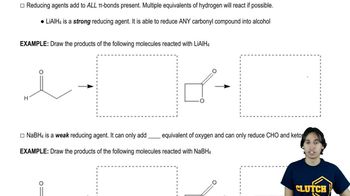
    Lithium aluminum hydride (LiAlH4 or LAH) is the strongest reducing agent commonly used.
  • What types of compounds can LAH reduce?

    LAH can reduce any carbonyl compound, including aldehydes, ketones, esters, carboxylic acids, and amides, to alcohols.
  • What is the product when LAH reduces an aldehyde?

    The product is a primary alcohol, formed by adding two hydrogens to the carbonyl carbon and oxygen.
  • What happens when LAH reduces a cyclic ester?

    LAH breaks the ester bond and adds hydrogen, resulting in two alcohol groups (a diol).
  • What is sodium borohydride (NaBH4) used for in reduction reactions?

    NaBH4 is a weaker reducing agent used to reduce only aldehydes and ketones to alcohols.
  • Which functional groups cannot be reduced by NaBH4?

    NaBH4 cannot reduce esters, carboxylic acids, or amides because they are too highly oxidized.
  • What is the difference in reactivity between LAH and NaBH4?

    LAH is strong and reduces almost all carbonyls, while NaBH4 is weaker and only reduces aldehydes and ketones.
  • What is meant by 'saturation' in the context of reduction?

    Saturation refers to adding hydrogens to a molecule, converting unsaturated compounds (with pi bonds) into saturated ones.
  • What is a hydride ion and what role does it play in reduction?

    A hydride ion (H-) is a negatively charged hydrogen atom that attacks the carbonyl carbon during reduction.
  • What is the outcome when NaBH4 is used on an aldehyde?

    NaBH4 reduces the aldehyde to a primary alcohol by adding hydrogens.
  • Why can't alcohols be attached to two carbons in a ring after reduction of a cyclic ester?

    Alcohols cannot have two bonds to carbons; if both sides are attached, it would be an ether, not an alcohol.
  • What should you remember when predicting the products of reduction with LAH or NaBH4?

    Remember that LAH reduces almost all carbonyls to alcohols, while NaBH4 only reduces aldehydes and ketones.