Back

Secondary Protein Structure definitions

Control buttons has been changed to "navigation" mode.
1/13
  • Secondary Structure

    Level of protein organization formed by hydrogen bonding between backbone atoms, resulting in repeating patterns like spirals or sheets.
  • Hydrogen Bond

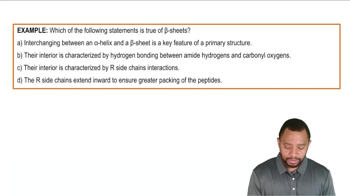
    Intermolecular force between an amide hydrogen and a carbonyl oxygen, stabilizing protein backbone arrangements.
  • Amide Hydrogen

    Backbone atom bonded to nitrogen, participating in hydrogen bonding with a carbonyl oxygen in protein structures.
  • Carbonyl Oxygen

    Backbone atom double-bonded to carbon, serving as a hydrogen bond acceptor in protein folding.
  • Alpha Helix

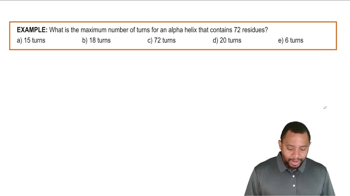
    Right-handed spiral structure stabilized by internal hydrogen bonds, with side chains projecting outward.
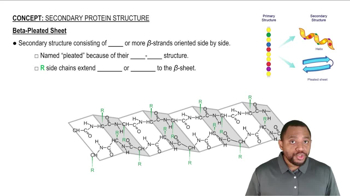
  • Beta Pleated Sheet

    Zigzag arrangement of beta strands aligned side by side, stabilized by hydrogen bonds between chains.
  • Beta Strand

    Extended segment of polypeptide chain that aligns with others to form a sheet-like structure.
  • Peptide Bond

    Covalent linkage between amino acids, forming the backbone of protein chains.
  • R Group

    Variable side chain of an amino acid, positioned outward in helices or above and below sheets due to spatial constraints.
  • Residue

    Individual amino acid unit within a polypeptide chain, contributing to the overall structure.
  • Right-Handed Spiral

    Clockwise coiling pattern characteristic of the alpha helix in protein secondary structure.
  • Primary Structure

    Linear sequence of amino acids in a protein, connected by peptide bonds, serving as the foundation for higher structures.
  • Polypeptide Chain

    Long sequence of amino acids linked by peptide bonds, capable of folding into complex structures.