Back

Side-Chain Halogenation definitions

Control buttons has been changed to "navigation" mode.
1/14
  • Alkyl Side Chain

    An alkyl group directly bonded to a benzene ring, often the site of unique reactivity due to its proximity to aromatic stabilization.
  • Benzylic Position

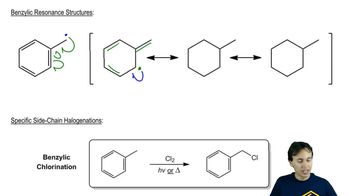
    The carbon atom adjacent to a benzene ring, notable for its enhanced stability from resonance with the aromatic system.
  • Resonance Structure

    A depiction showing electron delocalization, especially for radicals or charges, across multiple positions in a molecule.
  • Benzylic Radical

    A highly stabilized species formed at the benzylic position, capable of extensive electron delocalization into the aromatic ring.
  • Conjugation

    A system where alternating single and multiple bonds allow for electron delocalization, increasing stability and reactivity.
  • Side Chain Reaction

    A transformation occurring on an alkyl group attached to benzene, distinct from reactions on the aromatic ring itself.
  • Benzylic Chlorination

    A radical process where chlorine selectively replaces a hydrogen at the benzylic position, often using heat or light.
  • Benzylic Bromination

    A selective radical substitution at the benzylic position using NBS to generate trace bromine and avoid side reactions.
  • NBS

    A reagent, N-bromosuccinimide, used to provide controlled, low concentrations of bromine for selective benzylic bromination.
  • Initiation Step

    The phase in a radical mechanism where radicals are first generated, often by heat or light.
  • Propagation Step

    The sequence in a radical reaction where the reactive intermediate reacts to form product and regenerate a radical.
  • Termination Step

    The stage in a radical process where two radicals combine, ending the chain reaction.
  • Electrophilic Aromatic Substitution

    A reaction type where an aromatic hydrogen is replaced by an electrophile, distinct from side chain transformations.
  • Allylic Reaction

    A transformation involving a position next to a double bond, mechanistically similar to benzylic reactions.