Back

Side-Chain Halogenation quiz

Control buttons has been changed to "navigation" mode.
1/15
  • What is the benzylic position in an alkyl side chain attached to benzene?

    The benzylic position is the carbon atom directly next to the benzene ring in an alkyl side chain.
  • Why are benzylic radicals particularly stable?

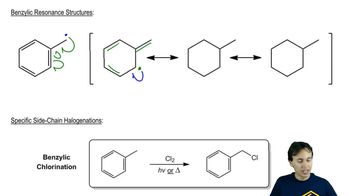
    Benzylic radicals are especially stable due to resonance and conjugation with the benzene ring, allowing the radical to delocalize over the ring.
  • How does the stability of benzylic radicals compare to other radicals?

    Benzylic radicals are the most stable type of radicals because their unpaired electron can resonate throughout the benzene ring.
  • What type of mechanism do benzylic chlorination and bromination follow?

    Both benzylic chlorination and bromination follow a radical mechanism involving initiation, propagation, and termination steps.
  • What reagent is commonly used for benzylic bromination and why?

    NBS (N-bromosuccinimide) is used because it provides trace amounts of bromine, preventing unwanted side reactions.
  • What initiates the radical reaction in benzylic chlorination?

    Heat or light is used to initiate the formation of chlorine radicals in benzylic chlorination.
  • How are benzylic side-chain reactions different from electrophilic aromatic substitution (EAS)?

    Side-chain reactions occur at the benzylic position and do not involve the aromatic ring directly, unlike EAS which modifies the ring itself.
  • What is the main product of benzylic chlorination?

    The main product is a benzene ring with a chlorine atom attached to the benzylic position.
  • Why is NBS preferred over Br2 for benzylic bromination?

    NBS provides only trace amounts of bromine, minimizing cross reactions and ensuring selective bromination at the benzylic position.
  • What is the similarity between benzylic and allylic halogenation reactions?

    Both involve radical mechanisms and occur at positions adjacent to a conjugated system (benzene for benzylic, alkene for allylic).
  • What are the three main steps in a radical halogenation mechanism?

    The three steps are initiation, propagation, and termination.
  • What happens to the radical formed at the benzylic position during resonance?

    The radical can delocalize and move around the benzene ring, forming multiple resonance structures.
  • Why are side-chain halogenation reactions possible at the benzylic position?

    They are possible because the benzylic position is highly stabilized by resonance, making radical formation favorable.
  • What is the role of heat or light in side-chain halogenation?

    Heat or light provides the energy needed to generate halogen radicals that initiate the reaction.
  • How can you relate the mechanism of benzylic halogenation to allylic halogenation?

    The mechanisms are essentially the same, with the only difference being the substrate: benzene for benzylic and alkene for allylic.