Back

Side-Chain Oxidation definitions

Control buttons has been changed to "navigation" mode.
1/13
  • Side Chain Oxidation

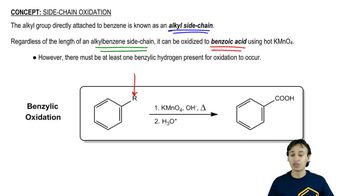
    Transformation where an alkyl group attached to benzene is converted to a carboxylic acid, regardless of chain length.
  • Alkyl Side Chain

    A hydrocarbon group directly bonded to a benzene ring, serving as a site for specific chemical reactions.
  • Benzene

    A six-membered aromatic ring that provides a stable platform for various substitution and oxidation reactions.
  • Potassium Permanganate

    A strong oxidizing agent, often used hot, that cleaves alkyl side chains on benzene to form carboxylic acids.
  • Benzoic Acid

    A carboxylic acid directly attached to a benzene ring, formed by complete oxidation of an alkyl side chain.
  • Carboxylic Acid

    A functional group characterized by a carbon double-bonded to oxygen and single-bonded to a hydroxyl group.
  • Benzylic Hydrogen

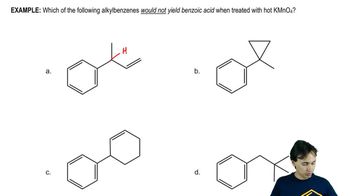
    A hydrogen atom attached to the carbon directly bonded to a benzene ring, essential for side chain oxidation.
  • Oxidizing Agent

    A substance that facilitates the loss of electrons, enabling the transformation of alkyl side chains to acids.
  • Reaction Conditions

    A specific set of reagents—KMnO4, base, heat, and acid—required for efficient side chain oxidation.
  • Aromaticity

    A property of cyclic, planar molecules with delocalized electrons, providing stability to benzene and its derivatives.
  • Alkylbenzene

    A compound consisting of a benzene ring bonded to an alkyl group, susceptible to oxidation under certain conditions.
  • Base

    A component in the oxidation process that helps facilitate the reaction, typically used before acidification.
  • Heat

    A condition applied to increase the rate and completeness of the oxidation reaction with KMnO4.