Back

Silyl Ether Protecting Groups quiz

Control buttons has been changed to "navigation" mode.
1/15
  • What is the purpose of using a protecting group for alcohols in organic chemistry?

    Protecting groups prevent alcohols from reacting during certain steps, allowing selective reactions with other parts of the molecule.
  • What is a silyl ether protecting group made of?

    A silyl ether protecting group contains silicon (Si) instead of oxygen (O), forming a Si-O bond with the alcohol.
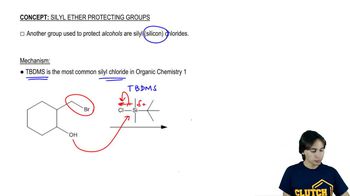
  • What is the most common silyl chloride used to make silyl ethers in Organic Chemistry?

    TBDMS (tert-butyldimethylsilyl chloride) is the most common silyl chloride used to create silyl ethers.
  • How does the alcohol react with TBDMS chloride to form a silyl ether?

    The alcohol attacks the silicon atom, causing the chlorine to leave and forming a silyl ether bond.
  • What happens to the chlorine ion after it is kicked off during silyl ether formation?

    The chlorine ion acts as a base and deprotonates the alcohol, resulting in HCl and the protected silyl ether.
  • Why are silyl ethers useful as protecting groups for alcohols?

    Silyl ethers are unreactive to strong bases and other reagents, allowing selective reactions with other functional groups.
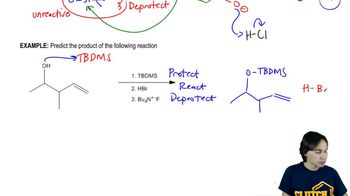
  • What is the general sequence of steps when using a silyl ether protecting group?

    The sequence is: protect the alcohol, perform the desired reaction, then deprotect to restore the alcohol.
  • What reagent is commonly used to deprotect silyl ethers?

    A reagent containing a fluorine atom, such as tetrabutylammonium fluoride (TBAF), is used to deprotect silyl ethers.
  • How does the deprotection mechanism of silyl ethers work?

    The fluoride ion attacks the silicon, breaking the Si-O bond and releasing the alcohol.
  • What is the final product after deprotection of a silyl ether protecting group?

    The final product is the original alcohol, restored after removal of the silyl group.
  • What functional group does the silyl ether protect during reactions?

    The silyl ether protects the alcohol functional group from unwanted reactions.
  • What happens if you do not protect the alcohol during a reaction with strong bases?

    The alcohol may react or be deprotonated, interfering with the desired reaction on other functional groups.
  • What is the structure of TBDMS, and why is it important to know?

    TBDMS has a silicon atom bonded to two methyl groups and a tert-butyl group; knowing its structure helps understand the mechanism.
  • What is the role of the protecting group in multi-step organic synthesis?

    It allows selective reactions on other functional groups while preventing unwanted reactions with the alcohol.
  • What should students practice to master silyl ether protecting groups?

    Students should practice drawing the mechanism and predicting the final product after protection and deprotection steps.