Skeletal Structure quiz #1 Flashcards

Skeletal Structure quiz #1
Control buttons has been changed to "navigation" mode.
1/10
  • How do you determine the number of hydrogen atoms in the skeletal (bond line) structure of an alkane?
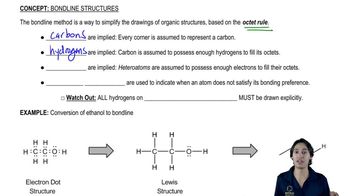
    To determine the number of hydrogen atoms in a skeletal structure of an alkane, count the number of bonds each carbon atom forms with other atoms. Each carbon should have four bonds to satisfy the octet rule. The number of hydrogens on each carbon is equal to 4 minus the number of bonds it forms with other atoms (including carbons and heteroatoms). Sum the hydrogens for all carbons in the molecule.
  • How do you convert the condensed formula (CH3)2CHCH2CHClCH3 into a skeletal (bond line) structure?
    To convert (CH3)2CHCH2CHClCH3 into a skeletal structure, first identify the carbon chain and substituents. Draw a zigzag line for the carbon backbone, with each vertex representing a carbon atom. Attach the chlorine atom (Cl) to the appropriate carbon, and do not draw hydrogens on carbons; they are implied. Hydrogens on heteroatoms (if any) should be drawn explicitly.
  • What is the process for converting a given organic structure into a skeletal (bond line) drawing?
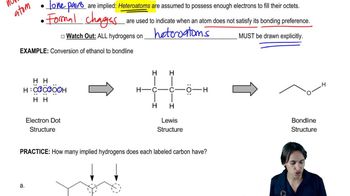
    To convert an organic structure into a skeletal (bond line) drawing, represent each carbon atom as a vertex or endpoint in a zigzag line, omit all carbon and hydrogen labels (except for hydrogens on heteroatoms), and explicitly draw all heteroatoms and any hydrogens attached to them. Use the octet rule to determine the number of implied hydrogens on each carbon.
  • How would you draw the skeletal structure for the linear form of D-glyceraldehyde?
    To draw the skeletal structure for the linear form of D-glyceraldehyde, represent the three-carbon backbone as a zigzag line. At one end, indicate the aldehyde group (–CHO) by drawing a double-bonded oxygen and a hydrogen attached to the terminal carbon. Attach the hydroxyl group (–OH) to the appropriate carbon, and explicitly show the hydrogen on the oxygen. Do not draw hydrogens on carbons; they are implied.
  • How do you draw the skeletal (bond line) structure for tert-butanol, (CH3)3COH?
    To draw the skeletal structure for tert-butanol ((CH3)3COH), represent the central carbon atom bonded to three methyl groups (each as a line extending from the central point) and one hydroxyl group (–OH). Explicitly draw the oxygen and its hydrogen, but do not show hydrogens on carbons.
  • What does each vertex or endpoint represent in a zigzag bond line structure?
    Each vertex or endpoint in a zigzag bond line structure represents a carbon atom. This convention helps simplify the drawing by omitting explicit carbon labels.
  • Why are lone pairs typically not drawn in bond line structures?
    Lone pairs are not drawn to avoid repetitive and cluttered drawings. They are implied for heteroatoms unless a formal charge is present.
  • When must formal charges be shown in a bond line structure?
    Formal charges must be shown when an atom does not satisfy its usual bonding preference. This helps clarify the electronic structure without drawing lone pairs.
  • What is a heteroatom in the context of skeletal structures?
    A heteroatom is any atom in the molecule that is not carbon. Common examples include oxygen, nitrogen, and fluorine.
  • Why are hydrogens attached to heteroatoms always drawn explicitly in bond line structures?
    Hydrogens on heteroatoms are drawn explicitly to avoid confusion about the atom's bonding and lone pairs. This ensures the structure is interpreted correctly.