SN1 Reaction quiz #1 Flashcards

SN1 Reaction quiz #1
Control buttons has been changed to "navigation" mode.
1/11
  • Which statement accurately describes the SN1 reaction mechanism?
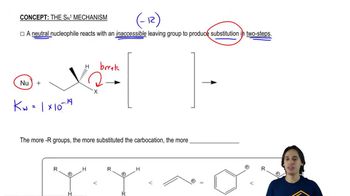
    The SN1 reaction mechanism proceeds in two steps: first, the leaving group dissociates to form a carbocation intermediate, and then the nucleophile attacks the carbocation. The rate-determining step is the formation of the carbocation, and the reaction rate depends only on the concentration of the substrate (alkyl halide).
  • Which type of alkyl halide undergoes an SN1 reaction the fastest?
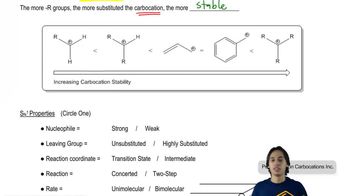
    Tertiary alkyl halides undergo SN1 reactions the fastest because they form the most stable carbocation intermediates.
  • Which alkyl halide is most reactive in an SN1 reaction?
    The most reactive alkyl halide in an SN1 reaction is the one that forms the most stable carbocation, typically a tertiary alkyl halide.
  • How does the structure of an alkyl halide affect the rate of an SN1 reaction?
    The rate of an SN1 reaction increases with the number of alkyl groups attached to the carbon bearing the leaving group; tertiary alkyl halides react faster than secondary, which react faster than primary.
  • Given two SN1 reactions, what factor determines which reaction will proceed at a faster rate?
    The reaction that forms a more stable carbocation intermediate (such as from a tertiary alkyl halide) will proceed at a faster rate in an SN1 reaction.
  • Which type of alkyl halide is most likely to undergo rearrangement during an SN1 reaction?
    Alkyl halides that can form more stable carbocations through rearrangement (such as hydride or alkyl shifts) are most likely to undergo rearrangement during an SN1 reaction, especially secondary alkyl halides adjacent to tertiary or more substituted carbons.
  • What is the rate law for the SN1 reaction mechanism?
    The rate law for the SN1 reaction is rate = k[alkyl halide], meaning it is first-order and depends only on the concentration of the substrate.
  • What are the key properties of the SN1 reaction mechanism?
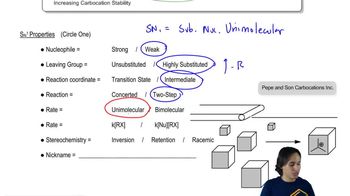
    Key properties of the SN1 reaction mechanism include: a two-step process with a carbocation intermediate, a weak (often neutral) nucleophile, a highly substituted (usually tertiary) substrate, first-order kinetics, racemization of stereochemistry, and common occurrence in polar protic solvents.
  • Describe the main features of the SN1 reaction mechanism.
    The SN1 reaction mechanism features a two-step process: (1) dissociation of the leaving group to form a carbocation intermediate, and (2) nucleophilic attack on the carbocation. It involves a weak nucleophile, a highly substituted substrate, first-order kinetics, and leads to racemization at the reaction center.
  • What are the predicted products of an SN1 reaction at a chiral center?
    An SN1 reaction at a chiral center produces a racemic mixture of enantiomers because the nucleophile can attack the planar carbocation intermediate from either side.
  • How should compounds be arranged in order of SN1 reaction rate from fastest to slowest?
    Compounds should be arranged from fastest to slowest SN1 reaction rate as follows: tertiary alkyl halide > secondary alkyl halide > primary alkyl halide, based on the stability of the carbocation intermediate formed.