SN2 Reaction quiz #1 Flashcards

SN2 Reaction quiz #1
Control buttons has been changed to "navigation" mode.
1/17
  • What factors determine which SN2 reaction in a pair will proceed faster?
    The SN2 reaction will proceed faster for the substrate with less steric hindrance (less substituted carbon) and with a stronger, negatively charged nucleophile. The more accessible the electrophilic carbon, the faster the reaction.
  • How does the energy diagram of an SN2 reaction appear?
    The energy diagram of an SN2 reaction shows a single transition state at the highest energy point, with no intermediate. The reactants proceed directly to products in one concerted step.
  • Which type of compound undergoes an SN2 reaction most readily?
    Compounds with a primary (unsubstituted or minimally substituted) electrophilic carbon undergo SN2 reactions most readily due to minimal steric hindrance.
  • What determines which of two SN2 reactions will have a faster rate?
    The SN2 reaction with the less hindered (less substituted) electrophilic carbon and a stronger nucleophile will have a faster rate.
  • Why is 2-bromo-2-methylpropane unable to undergo an SN2 reaction?
    2-bromo-2-methylpropane is unable to undergo an SN2 reaction because its electrophilic carbon is highly substituted (tertiary), causing significant steric hindrance that prevents backside attack by the nucleophile.
  • What best represents the transition state for an SN2 reaction?
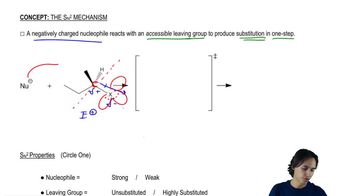
    The transition state for an SN2 reaction involves the nucleophile partially bonded to the electrophilic carbon while the leaving group is also partially bonded, resulting in a high-energy, unstable state with five groups around the carbon.
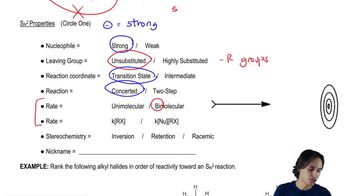
  • What are the key factors that favor SN2 reactions?
    Key factors that favor SN2 reactions include a strong, negatively charged nucleophile and an accessible, less hindered (preferably primary) electrophilic carbon.
  • How are curved arrows used to represent the mechanism of an SN2 reaction?
    Curved arrows in an SN2 reaction show the nucleophile attacking the electrophilic carbon from the backside and the simultaneous departure of the leaving group.
  • What is the expected product of a generic SN2 reaction?
    The expected product of an SN2 reaction is the nucleophile bonded to the electrophilic carbon, with the leaving group replaced and inversion of configuration at the carbon center.
  • How can ethyl acetate be prepared using an SN2 reaction?
    Ethyl acetate can be prepared by reacting an ethyl halide with acetate ion via an SN2 mechanism, where the acetate ion acts as the nucleophile and substitutes the halide.
  • What are the organic and inorganic products of a typical SN2 reaction?
    The organic product is the nucleophile bonded to the electrophilic carbon, and the inorganic product is the leaving group, now carrying a negative charge.
  • What are the main properties of the SN2 reaction mechanism?
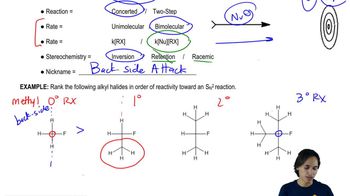
    The SN2 mechanism is bimolecular, concerted (one-step), involves backside attack, leads to inversion of configuration, and is favored by strong nucleophiles and less hindered substrates.
  • What is the major organic product formed in an SN2 reaction?
    The major organic product is the nucleophile attached to the electrophilic carbon, with inversion of configuration if the carbon is chiral.
  • What are the key features to consider in a typical SN2 reaction?
    Key features include a strong nucleophile, an accessible electrophilic carbon, a good leaving group, and inversion of configuration at the reaction center.
  • What are the best conditions to complete an SN2 reaction?
    The best conditions for an SN2 reaction are a strong, negatively charged nucleophile, a primary or minimally substituted electrophilic carbon, and a good leaving group.
  • What is the product of a generic SN2 reaction involving a chiral center?
    The product is the nucleophile bonded to the chiral carbon, with inversion of configuration (R to S or S to R) at that center.
  • How should compounds be ranked from most to least reactive in an SN2 reaction?
    Compounds should be ranked from most to least reactive in SN2 as follows: methyl halide > primary alkyl halide > secondary alkyl halide > tertiary alkyl halide, based on decreasing steric hindrance.